
The three distinct periods of John Hitchens’ career
A selection of John Hitchens sculptures will be on show at ROSA Botanical Art Fair 1-4 May, West Dean.

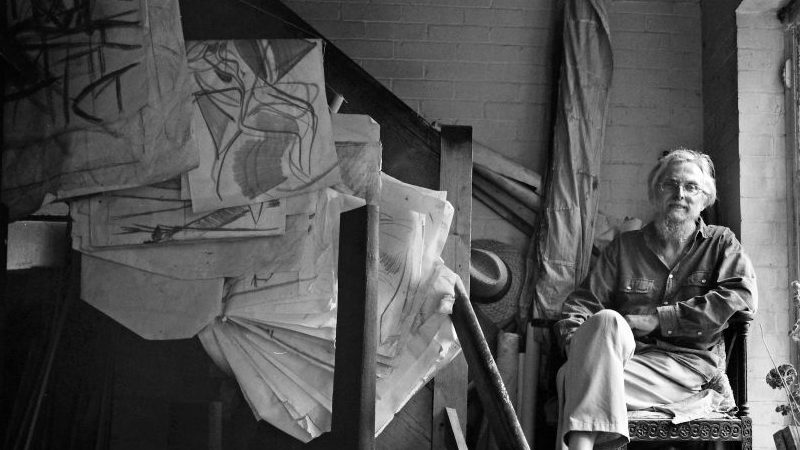
Photo © AK Purkiss
The paintings in the exhibition Patterns of Seeing at Moncrieff Bray Gallery this spring come from the studio of John Hitchens and fall into three distinct landscape groups: the ‘Duncton Hill’ series (1968–77), the ‘Far Wood’ series (1981–88), and the abstract works from the early 1990s to the present day. Together they trace a life devoted to looking – at land, at pattern, at the spaces between things – and to following where that looking might lead.
From an early age John achieved notable success. In his twenties he exhibited with the Piccadilly Gallery and later showed regularly with the London dealer Marjorie Parr. By 40 he had sold widely, including to public collections. Yet recognition as a figurative landscape painter never fixed him in place. From the late 1980s his work moved decisively towards abstraction. He embraced the tranquility of his Sussex home, where he explored new ideas and different artistic directions, Above Across the Far Wood, 1986 Oil on canvas, 45.2 x 213cm choosing experimentation over the expectations of the market.
A major catalyst in reintroducing his work to a wider public was the 2020 retrospective at Southampton City Art Gallery, which surveyed his output from the 1960s to the present. Earlier, Evolving Boundaries at Moncrieff Bray Gallery in 2008 had marked his first commercial exhibition for 20 years.
Duncton Hill
John grew up in a creative household, the son of the Modern British painter Ivon Hitchens. Though Ivon never formally taught him – “I learnt instinctively by trial and experiment” – the example of a life in painting was formative. From 1968 John became captivated by a single vista – the view from the edge of Duncton Hill across the Weald. He set up an outdoor studio, fixing his easel with guy ropes and bricks in the same spot. Each canvas was completed in a single day, in situ, some as many as seven foot in length.
There was enough complexity in that view – shifting seasons, light and shadow – to sustain nine years of investigation. The early Duncton paintings are expansive and lyrical, the Downs unfolding towards the horizon beneath swirling skies. By the mid-1970s a change occurs. The sky is gradually eliminated and the compositions become bolder and flatter. The land below – fields, orchards, woods – resolves into planes of colour. These explorations culminated in Landscape Symphony (1978), a 52-foot abstract commission for Christ’s Hospital School. The seeds of abstraction were already present within the figurative motif.

Oil on canvas, 45.2 x 213cm
Far Wood
John’s next sustained subject was the Far Wood, adjacent to his parents’ home at Greenleaves. Known since childhood, it offered a denser, more immersive world. Here there was no visible sky, which suited the direction in which his work was moving.
Working from a fixed position, he looked through gaps in the larches to chestnuts beyond and, further still, to the Downs. The paintings move in a threefold rhythm, threading between tree trunks that anchor the composition while perspective shifts from near to far. Space between forms becomes as important as the marks themselves; fewer brushstrokes carry greater responsibility.
Then came the Great Storm of 1987. The ancient trees of the Far Wood were levelled and the Graffham valley transformed. John recalls finding the familiar dark wood gone – replaced by a chaos of fallen trunks and, beyond them, unexpected vistas towards the Downs. After the storm he returned less frequently; from 1990 he no longer painted there. The destruction marked both an ending and a release.
Greenleaves
After 1987 John’s practice shifted. The house at Greenleaves – his father’s studio – became his own working space following his mother Mollie’s death. It evolved into a living installation of shells, pebbles, branches, feathers and bones – a collection of forms that fed directly into his art.
He began using physical elements of the landscape – wood, sand and stone – creating outdoor installations from fallen timber and ephemeral sand works at Selsey, photographed before the tide erased them. Painted wooden blades and carved ash sculptures grew from this engagement with material itself.
At the same time a new two-dimensional language emerged. Flights in a Cessna in 1990 revealed the land vertically – field boundaries, plough lines, footpaths and traces of cultivation forming a new vocabulary. Freed from the horizon, he adopted a restricted palette and concentrated on bands of tone and rhythm, echoing the woven patterns of his wife Ros’ textile practice.
Though the early figurative landscapes and recent abstract works may appear far apart, they are linked by patterns of seeing. Underlying all three stages is a belief in connection – between land and mark, material and memory. Painting for John is both calling and habit – a sustained act of attention to the natural world and to the endless possibilities it contains.
This is an abridged version of the catalogue essay by Elspeth Moncrieff that accompanies the retrospective. Patterns of Seeing, John Hitchens Past and Present shows at Moncrieff-Bray Gallery, nr Petworth, March 28 – April 18 www.moncrieff-bray.com
You can also see works on paper, wood and stone at Elements of Landscape, Gilbert White’s House, Selborne, Hampshire, April 15 – June 28. gilbertwhiteshouse.org.uk