

Lulah Ellender explores Nymans

In his poem, Failing and Flying, Jack Gilbert reframes Icarus’ fall not as a failure but as ‘coming to the end of his triumph’. Instead of seeing the myth as a tale of hubris and defeat, Gilbert celebrates endurance and endeavour. The poem is in my mind as I visit Nymans, the West Sussex National Trust house known as much for its ruins as for its beautiful landscape.
Bought in 1890 by Jewish émigré Ludwig Messel, Nymans was remodelled and developed into the country seat of a respectable, prosperous family. The Messels refashioned the house in a mock-Gothic style and created 30 acres of gardens that reflected their passion for horticulture and hybridisation. They were patrons of the Victorian-era plant-hunting trips, combining exotic species alongside the camellias, magnolias and rhododendrons for which the gardens became renowned.
But in February 1947 a devastating fire destroyed the Great Hall and part of the upper storey of the house. The ruins were never restored and have become a key feature of the landscape. It is a kind of Jekyll and Hyde house – respectable and orderly on one side, gaping and decaying on the other. There is a beauty in this decay, in the wisteria and ivy that tangle up walls opening onto sky; in the palms, euphorbia, ferns and salvia that soak up the sun outside the ruin; in the croquet lawn, Sunk Garden, Rock Garden, and Heather Garden that blithely continue their displays. The show goes on.
On a clear January day gardener Jon Keen, who has worked at Nymans for nearly two decades, is kindly showing me around. We have walked round a sweeping lawn spattered with daffodils, hellebores and snowdrops, cut through a hedge, passed across a neat Knot Garden, and arrived at the ruins. I used to bring my children here to run in the 300 acres of woodland (now an SSSI) and play croquet on the lawn. Back then, the ruins were closed – a backdrop rather than part of the garden. But in lockdown the Garden in the Ruins project brought life back within the newly stabilised walls.
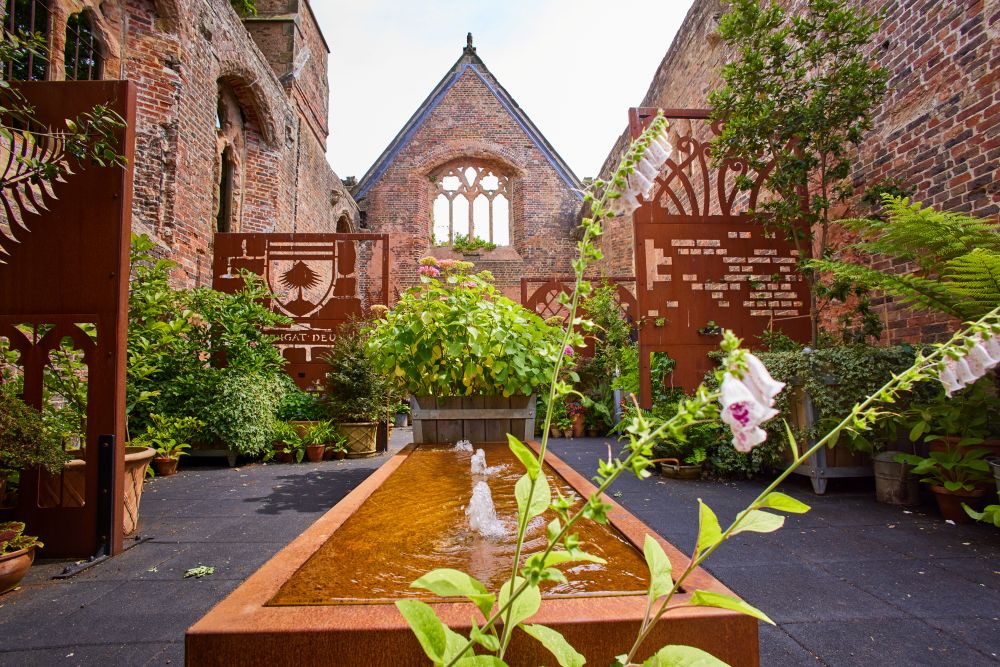
We pass a large oak tree standing in what would have been the main entranceway to the house and go through a wooden door. The allure of a secret garden, the romance of a ruin, the fact that we are there alone – it’s a quietly sublime moment. The Garden in the Ruins feels like a stage set, with metal screens depicting cedar trees standing like theatre wings – an homage to the screens Oliver Messel (artist and set designer) made for Glyndebourne Opera House. There is a water feature in the centre and the space is lined with planters and pots containing tree ferns, smaller ferns, Camellia ‘Leonard Messel’ (a Nymans original variety), and a variegated eucryphia ‘Mrs Comber’, named after a previous head gardener’s wife.
Even in winter, when I visit, the fresh green of the planting zings against the faded red brick walls. Pigeons flap in and out. What would have been bedroom windows gape onto the gardens and the ghost of a fireplace hints at the grandeur of the place before the flames engulfed it. Nature is adapting the structure, coexisting with the failure and absorbing the loss. There’s an intriguing sense of being both exposed and concealed. My imagination is alive with the past horror and the eerie present.
We move on to the Walled Garden, arriving at an entrance that reminds me of Caspar David Friedrich’s Churchyard Gate painting. The curved wall only partially surrounds the garden, sheltering but not fully containing the summer and spring borders, yew globes, Stewartia, and bulbs. Beyond, into the wilder Top Garden, we pass an old quarry that brings a prehistoric air, with gunnera, ferns, and a huge palm. Jon tells me that Nymans has the second most diverse range of planting of all National Trust properties, reflecting the pioneering horticultural heritage and spirit of its creators.
Nymans suffered a second catastrophe when the Great Storm of 1987 devastated the woodlands and flattened the pinetum. Not that visitors would know it, thanks to clever planting and a huge restoration effort. Now, like all gardens, it must navigate our changing climate. The old Rose Garden has been cleared as the roses weren’t doing well there any more. It will be replanted to create a romantic but more diverse space. For now, it’s home to a scattering of wildflowers. The garden team want to create hardier plants that can withstand harsher conditions, breeding and propagating, just as the Messels did.
Carved into an entrance on the house is the motto: DUM SPIRO SPERO (while I breathe I hope). While the ruins remain and the gardens flourish, so the memories of the Messel family and their teams of gardeners endure. The fire destroyed precious books, belongings and a beloved home. But it created something unique. The ruins gave Nymans a new identity, creating value from vulnerability. The place invites us to accept that things fail, and to remember that connection and hope endure. To remember that Icarus also flew.
Lulah Ellender is the author of the memoirs Elizabeth’s Lists (Granta 2018) and Grounding: Finding Home in a Garden (Granta 2022)