

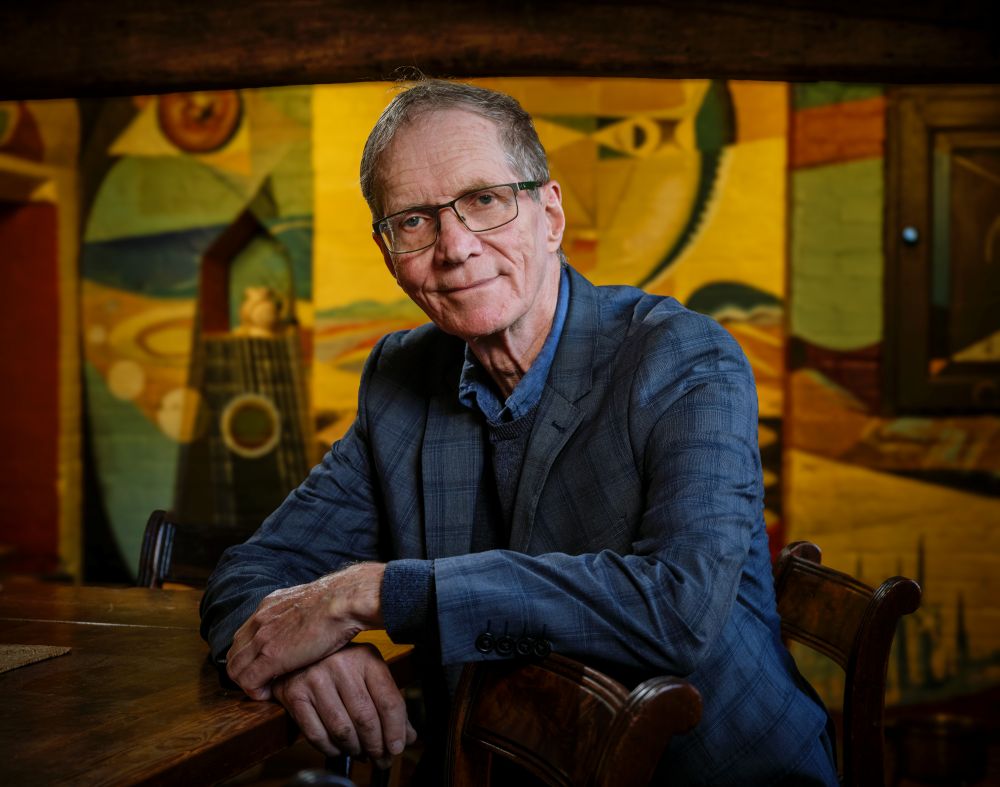
Antony Penrose, archivist, curator, filmmaker
Are you local to Sussex?
I was born in London, but my parents, the Surrealists Roland Penrose and Lee Miller, moved to Farleys Farm in 1949, when I was about 18 months old. I’ve travelled a lot, but Chiddingly has always been home.
You pronounce ‘Chiddingly’ with the emphasis on the last syllable…
That’s the traditional way: ‘Chiddingly’ has Old English roots. ‘Lye’ meant a clearing in the woods, so it was ‘the clearing where the Chid tribe lived’. There are a number of ‘Lye’ villages in the Sussex Weald – Hellingly, East Hoathly, Clarklye – connected by ancient footpaths, reflecting a time when this was a self sufficient, industrious local society. Topographically, the area is marked by the remnants of iron ore extraction and clay pits, industries that shaped both the landscape and the community.
I see your parents as being ‘urbanites’. How did they adapt to rural life in Sussex?
Roland, though raised near Watford, always cherished the countryside and had a deep appreciation for rural life, perhaps from his time spent on farms during WWI, so he was always a frustrated urbanite. Lee was initially not keen on the idea of country living. However, after experiencing f irst-hand the horrors of Europe’s concentration camps – Dachau, Buchenwald, among others – and documenting the famine across post-war Europe, she developed an acute appreciation for the importance of food. When we moved here, she quickly expanded the garden into the neighbouring field, growing staple crops – carrots, potatoes, parsnips – along with more exotic varieties, like American corn on the cob, French asparagus and globe artichokes.
You didn’t realise the extent of your mother’s photographic career until after her death, in 1977…
I was 30 at the time, and as well as working on the farm I’d just finished my first documentary, about the history of the horse, shot on location in Iran, which was aired on ITV. Lee hadn’t talked to me about her career, she’d been rather ‘difficult’, even if her battles with alcohol were largely behind her. One day my partner Susanna discovered a cache of Lee’s work in the attic, and that find changed everything. I discovered that Lee had worked as a war photographer, travelled extensively, and produced thousands of photos, including in Romania and Egypt. That she’d worked with Man Ray. That she’d had studios in Paris and New York, which was remarkable for a woman in her era. We sought out a photo historian, Valerie Lloyd, who confirmed the archive’s world class value – intact, unique, a treasure trove of one artist’s complete output, previously unseen. We chose not to donate it to a museum, where it might never see the light of day, but instead created a private archive, organizing exhibitions, and selling reproduction rights and fine prints. I asked Valerie if we could possibly make this work financially. She replied: ‘it would be a first if you did.’
How did you manage this transition into becoming photographic archivists and curators?
We were determined to make it work, and we had fallen in love with the material. But it was difficult: Susanna had worked as a ballet teacher; I was a dairy farmer and filmmaker. Fortunately, my father had many contacts in the art world, such as the Victoria & Albert Museum, who offered excellent advice. Our first exhibition was in 1984 at the Gardner Arts Centre in Falmer, the first-ever joint show of Lee Miller and Roland Penrose. Tragically, Roland died just days before that show opened.
How did your mother’s life and work gain wider recognition?
By another stroke of luck, the publisher Thames & Hudson heard about the archive, and their chief, Thomas Neurath, recognized my parents’ names. Surrealism is deeply woven into this, because surrealists respect and love and invite the opportunities of chance. After reviewing the collection, he suggested there should be a biography of Lee Miller. Though I had little writing experience (I’d been the overseas correspondent for Farmers Weekly for some years!), I somehow found myself volunteering for the job. David E Scherman, Lee’s wartime buddy, became my de facto editor, providing invaluable interview material and feedback. He helped me grasp the multiple dimensions – the ‘lives’ – of Lee Miller. And that became the title of the book, published in 1985: The Lives of Lee Miller.
Your efforts have seen Lee Miller’s reputation grow and grow. What were some of the key milestones?
After an extremely popular show at The Photographers Gallery in London in 1985, which coincided with the publication of the book, we were given a show at the Corcoran Gallery in Washington in 1989, which then toured Europe, Australia and New Zealand. An exhibition at The National Galleries in Edinburgh in 2001 was particularly pivotal: one building devoted to Roland Penrose, the other to Lee Miller. From there, Lee’s reputation grew internationally, with further shows at the National Portrait Gallery, the Victoria & Albert Museum, the Imperial War Museum, and, as we speak, at Tate Britain.
We are extremely indebted to our in-house master printer Carole Callow, who was with us for 35 years, producing darkroom archival gelatin silver prints from original negatives, of astonishing quality, which were placed in exhibitions and collections around the world. When she retired and the traditional paper supply ended, we shifted to digital for some prints while still maintaining traditional darkroom-type methods for collectors’ editions.
How has the film Lee, about your mother, increased your outreach?
The film had a massive impact: the publicity doubled our visitor numbers at Farleys almost overnight and brought global attention to Lee Miller’s story. While the film was especially successful in Europe and Australia, it struggled in the United States due to both market access and cultural factors: it’s an independent production with challenging themes, and those don’t always find a wide audience there. But among those who did see it, especially within independent cinema circles, the response was very positive.
The film’s authenticity came from it being a women-led project, with a female director, producer, screenwriters, and a lead performance by Kate Winslet that was uncannily true to my mother both in looks and mannerisms. Kate spent hours in our archive, studying Lee’s writings, letters, and photographs, really immersing herself in the source material rather than relying on second-hand accounts.
Have we reached ‘peak Lee Miller’? It’s hard to say.
There are always new galleries and audiences to reach. We have exhibits planned for the Musée d’Art Moderne in Paris and the Art Institute of Chicago, and would love to play other cities like Brussels, Copenhagen, Amsterdam or Oslo. It’s important to us to show locally, too – we keep two galleries running on our own site and are featured regularly in group exhibitions, such as the Sussex Modern show at Towner Eastbourne, which we were delighted to be involved with. We try to support emerging photographers, especially women, though we don’t have a strict gender policy.
Lee’s remarkable life story would be great for a Netflix style series…
Yeah, there are some vague discussions going on about that. Lee’s life was so episodic it would divide up nicely into a series, whether it would be five or 11 or 25 episodes. We’ll see what happens.
With all this attention on Lee Miller, has Roland Penrose fallen by the wayside?
Roland is very well respected, and we’re often making loans of his works to international exhibitions, but interest in British Surrealism is currently limited, and there hasn’t been a solo show for some time. We’re working on that… it’ll happen.
Do you feel you’ve had to set aside your own creative work in order to champion your parents’ legacy?
I no longer take photographs or make sculpture as I once did, but that’s by choice. I’ve had a privileged existence, travelling the world and working with major collections, experiences most people only dream of. My daughter Ami is now taking 22 the lead at Farleys Farm and the Lee Miller Archive, allowing me to step back somewhat. She’s incredibly competent and a great ambassador for the legacy. So, when things settle down, perhaps I’ll return to my personal projects, though I probably won’t use 16mm film for my documentaries anymore, it’s just too expensive.
What does Sussex represent to you, beyond being simply a place to live?
Sussex is truly a cultural and artistic hub, full of history and activity across the arts, both visual and performing. There’s always something happening: new galleries, festivals, exhibitions. And I feel particularly anchored to the traditions of the Weald: the agricultural landscape, the oak and chestnut woodland, the rolling countryside and the wriggly roads are all central to who I am.