

David Blandy on his latest, site-specific film project
What is The Commons, and how did its history shape your project?
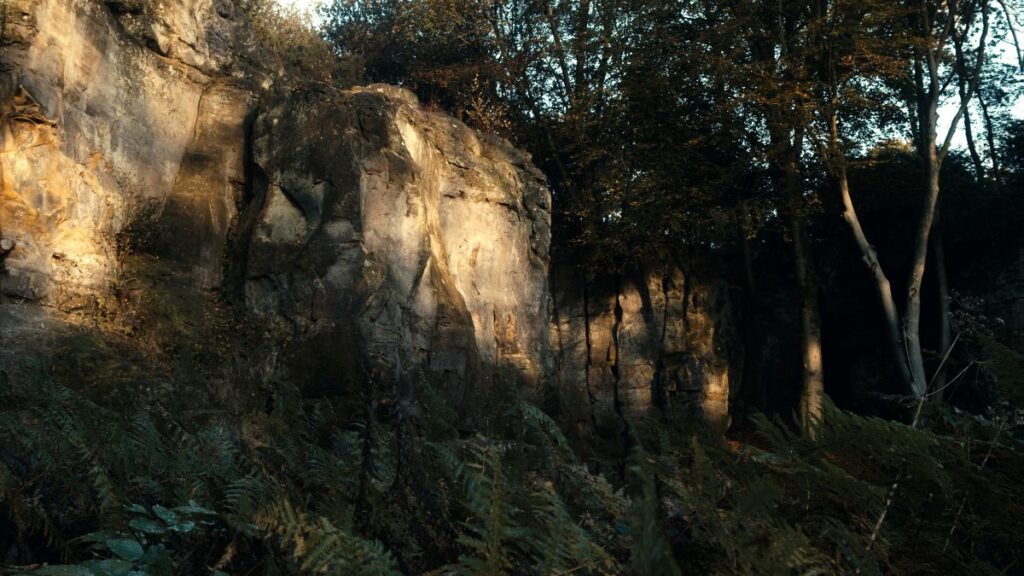
The Commons, incorporating Tunbridge Wells Common and Rusthall Common, is a stretch of preserved semi-wild land, with deep historic resonance, that weaves through the centre of Tunbridge Wells. Its preservation dates back to the Victorian era, and it’s still a shared, public space today. It hosts diverse habitats – woodland, heath, grassland – and supports a wide range of wildlife, from ancient ferns to deer. There’s a seam of incredible sandstone rocks running through the site, dating back to when the area was covered in water.
What’s your film Commons all about?
The idea was to craft a narrative piece featuring monologues by different objects, largely chosen from the collection of the Amelia Scott Museum in Tunbridge Wells (where the work is presented), and The Beaney in Canterbury. These include a taxidermied fox, crow and kingfisher, a crystal, a seed pod, a 135-million-year-old fossilised bone, and a fern from The Commons. I was interested in the histories these objects hold, and how, across time, their stories might connect with viewers. This structure allowed me to engage with themes of transformation: what these objects were before and what they’ve become. I also included a broken mobile phone into the cast of characters.
The three-dimensional scans of these objects are interspersed with archive footage from 1930s filmmaker Frank P Barnitt, who shot extensively in and around the Commons, which I sourced from the Screen Archive South East. Exploring both the collection of objects and the surrounding landscape opened up possibilities for reimagining ‘common spaces’, not just as protected wilderness, but as sites for storytelling and community. Walking those grounds, I could sense layers of history, and that became a foundation for the work.
How did you immerse yourself in the site and its history?
We did a walk with the Amelia Scott’s head of collection, tracing key geological and historical sites. Then we spent a lot of time in the area, walking, filming, climbing the rocks. The rocks themselves tell stories, some dating back millions of years, and the site has always been evolving: from a wild place to a pleasure resort within a commuter town. The many myths emerging from the site – such as Toad Rock being an ancient sphinx – add further layers to this history.
We?
I collaborate closely with Claire, my partner. She does all the camera work and we edit together. It’s very much a joint practice, blending our perspectives and skills, and that extends the collective spirit of the entire piece.
There’s a connection to The Canterbury Tales in your project. How does this play out?
The call-out for the project came from the Film and Video Umbrella, inviting artists to respond to themes in The Canterbury Tales, but also to connect with specific sites. Chaucer’s tales are essentially about society talking to itself in a time of change. I wanted to echo that, via objects, across centuries, bringing in ideas from object-oriented ontologies.
Please explain that term…
It’s a kind of philosophy that shifts focus away from human-centred thinking and places objects themselves, whether natural, artificial, living, or inert, at the heart of metaphysical inquiry. It argues that objects exist independently of human perception. Today, anything from a phone to an ocean can be seen as an ‘object’ with a story. In essence, I aimed to ‘decentre’ the human, showing how everything is interconnected.
What was your process for collecting voices and scripting these narratives?
I wrote scripts for each object, then put out a call for voices from the Tunbridge Wells area. Over 50 people responded, many with deep roots in the area, but also individuals originally from Zimbabwe and Bristol. Each of the three candidates we chose brought something unique, adding texture and authenticity to the project. Some voices reappeared in different objects’ narratives, showing how identity and perspective can shift.
How are spirituality and psychogeography reflected in the piece?
I’m not religious in a conventional sense, but I am fascinated by collective consciousness and the way spaces accumulate meaning. There’s something almost spiritual about standing next to ancient rocks at sunrise – being present in that ‘deep time’, yet aware of life’s impermanence. The project’s psycho-geographical side comes from breaking down the site’s many histories, exploring how stories and experiences layer upon one another, shaping what the place is now.
What impact do you hope the project has?
I’d like viewers to enter into that contemplative space – to stand still, consider the histories beneath their feet, and possibly reimagine their relationship to place, history, and each other. By giving voice to objects and sites, I hope to create new possibilities for dialogue and reflection. We need to converse, across boundaries, across generations, across time. To live in common, rather than atomised across different spaces.
Commons – a film by David Blandy, The Amelia Scott, Tunbridge Wells, runs until January 11.