

Imogen Lycett Green meets East Hoathly man of oak Keith Pettit
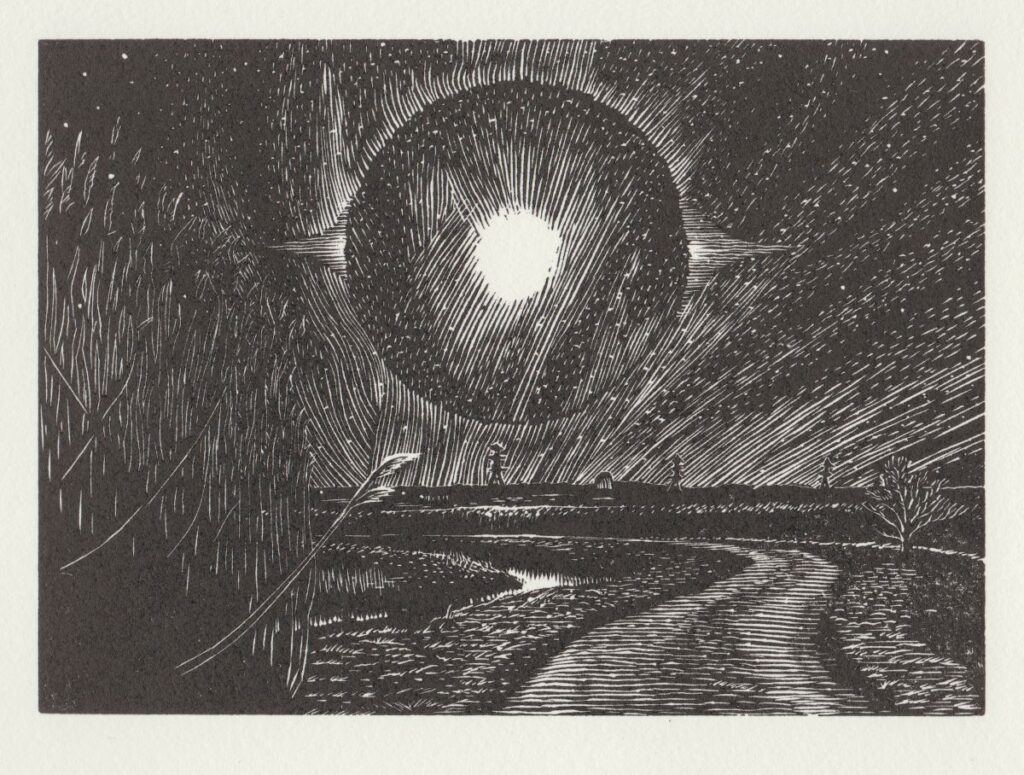
paper, 140x100mm, edition of 125
Pettit is possibly a Huguenot name, from ‘petit’, the French for ‘small’, but wood engraver and sculptor Keith Pettit is no woodland sprite. Over six feet tall, and broad-shouldered to boot, this man looms large in the room. He is smiling, not glowering, but there is, nonetheless, something towering about him.
His studio – in a parking lot in the lost-in-the-country Low Weald village of East Hoathly – feels too little for him, like it’s a childhood jumper he has grown out of. “I’ve been here 30 years,” he says. “I like familiar things. Coffee?” Pettit’s shelves spill with titles like Animals Under the Rainbow, The Spirit of the Downs and John Nash: The Landscape of Love and Solace and behind his desk is a handsome 1849 Hopkinson & Cope ‘Albion’ hand-lever printing press. On more shelves, wood blocks are neatly stacked, wrapped in brown paper, with titles like ‘Night Flows’ and ‘Beyond Earth’s Bounds’ written in Pettit’s sloping hand. And everywhere, there is his work: moonlit woodcuts in wooden frames and sinuous torsos of elm and oak, dancing on iron spokes.
Maybe these three cramped adjoining rooms fitted him once? Talking over choral music – The Gesualdo Six’s new album Radiant Dawn plays on speaker – Pettit recalls what a nipper he used to be when at secondary school in Hailsham. “Hailsham was quite violent in the 1980s,” he says. “I was smaller than the others. I had the piss taken out of me – I was dyslexic, liked drawing, was disruptive – and got beaten up on a regular basis.” He recalls laying on the pillow one night and there not being a place on his head that did not hurt. “I hit puberty late and only when I was 17 or so, did I start to grow.” Some of those contemporaries he fought with in the playground are his friends in this village now, and he brought up his two kids with their kids. For Pettit was born in this locality, grew up here, is of here in a way that few people are ‘of anywhere’ anymore. “When I was 19, I set off with a backpack around America,” he says. “I didn’t last long, and when I came back I knew I never wanted to leave this place.” He is not sure if that says he’s ‘insecure’ (his word) or a simply a man who knows where his heart is.
While his sculptures and woodcuts sell far and wide, Keith Pettit is known in the local pub as ‘Bonfire Guy’. He has been designing the East Hoathly Bonfire sculptures for over 20 years and in fact his whole artistic practice stems from this ancient rural tradition. East Hoathly & Halland Carnival Society is rooted more in Remembrance than anti Catholicism. The organisation was revived after WWI by a local headmaster. “It is a carnival, it’s tribal,” says Pettit. “We are proud of what we make, and it’s also a community thing – the wood gathering (which takes all year), the building, and I get to hang out with my mates.” When he began to make Bonfire sculptures Keith was working as a sign painter, a trade he took to when he was offered an apprenticeship. He was good at it, and because he married young and had two kids, he needed an income. The culture of Bonfire, embedded in men’s talk in the village, was about initiation and belonging, and he wanted to be part of it. But when they asked him to help, he found himself more creative director than master builder. There was more meaning in the making of something beautiful than burning it. “I finally had to admit to myself that I was an artist and that’s what I wanted to be.”
It wasn’t easy, however, to define himself in this way, in a rural community where making art was scoffed at. Art was for other people. “I was a snob too,” says Keith. “But it was irreversible, that feeling of wanting to realise my ideas.” While we are talking, people keep popping in: the man who photographs Keith’s sculptures, a builder from next door who needs to fill a bucket with water from Keith’s Butler’s sink, and a friend who is working on this year’s Bonfire sculpture – of Nike, Greek Goddess of Victory – with Keith. Pettit’s studio is clearly a hub. Even his father pops in to grab a drill bit. A small, wiry man in a boiler suit, who still works with his hands even though he is over 80, Pettit Sr comes in without looking up, as if he comes in every day. He ignores me, mumbles something to Keith, finds what he wants and wanders out again, intent on his task. “Bye, Daddy,” says Keith.
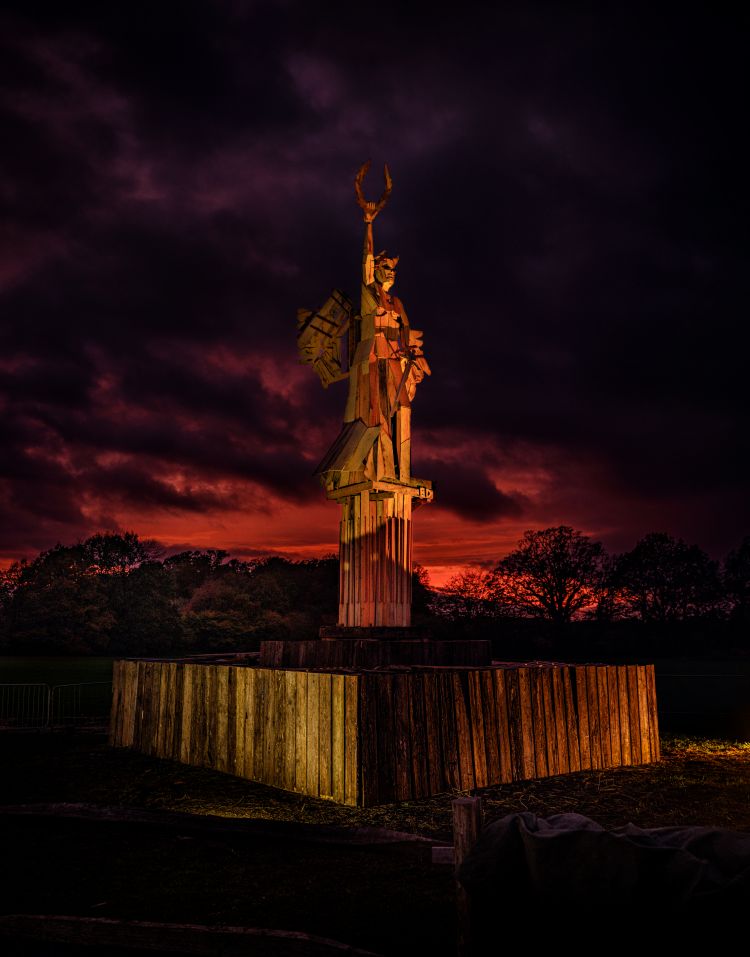
A Bonfire sculpture for East Hoathly
Carnival 2025. Photo by jimholden.co.uk
Turning back to me, Keith describes his family as a tribe of farmers and tradesmen who felt themselves fancy in East Hoathly. “We were the rural poor, with a chip on our shoulder.” There were always fights in the pub. While his mother came from nearby Herstmonceux, on the edge of the marsh, his father, a carpenter, came from here.
“He won’t slow down,” says Keith. “He’s a workaholic.” When his parents divorced, Keith, aged 13, chose to live with his father. “There was sawdust everywhere, window frames, shavings, the smell of wood and, of course, the toolbox.” Pettit picked up the tools and began playing with softwood. He was a country boy who spent his weekends – or playing truant on weekdays – on Pevensey Marsh. “It’s the closest we get, hereabouts, to wilderness,” says Keith. “It’s my favourite place, with the short-eared owls in winter, the marsh harriers. The marsh was only drained in the Victorian era, so it’s relatively new land, reclaimed, and there’s this magic feeling of it being untracked.” Everywhere else round here, he says, you can see the traces of centuries, even millennia-old cultivation: the iron industry, coppicing, grazing, building, moving by cart-track and road, crops, orchards, fencing. “Some of the lanes have been lanes for 2,000 years,” he says.
He may be a homebody, but it’s the wild places, and the myths wrapped around those places, that play over and over in his head. William the Conqueror landed not far from here. Keith identifies Norman ‘loan’ words: “That’s why there are two words for animals, because the Saxons reared them, and the Normans ate them: we call it a cow, but they called it ‘beef’; we call it a pig but they call it ‘pork’; we call it ‘deer’ but they call it ‘venison’,” he says, with glee. The dyslexic is fascinated by etymology. And local folklore, of course. His mother and grandmother told him stories in the car, of this 500-year-old oak or that ghost in those woods. As an adult, alongside the art books and local history, he reads novels: Thomas Hardy, Tom Cox’s Villager and Adam Thorpe’s Ulverton, a novel of dense layers and vernacular language, the telling of one place and the many voices that have inhabited it, in a kind of oral palimpsest. “I feel like I am ‘of the land’, like those Hardy characters, like Gabriel Oak,” says Pettit.
When the conversation turns to heartwood and sapwood, I sense Pettit’s deep relationship with oak. He shows me a trunk, cut in cross-section, tracing his finger round the rim. “This is the sapwood, then the heartwood, the hard stuff, is at the centre. The sapwood grows each year, just under the bark.” We are standing now amongst his torsos, as if they are the woods and we are finding our way through. Two of the torsos are blackened, primeval. “This is bog oak,” explains Pettit, running his hand over the shape. Bog oak?
“6,000 years old, retrieved from the marsh. The sea levels used to be much lower. Then, the rolling woodland, what we call the Weald, would have stretched down to the coast, with rivers running through it. Something happened – people argue over what, a tsunami perhaps, triggered by the collapse of the land bridge, Doggerland, around 8,000 years ago – and the low-lying woodlands were flooded.” He opens a book to show me a map. “The oaks are inundated with water and die – oaks don’t like getting their feet wet – and over time, are buried in silt, which preserves them.”
“For me, stone is dead, and I don’t like it that you have to quarry the earth to get it. You take something away. But wood is different – trees are freely given.” These bog oak sections came from a farmer on the marshes whom Pettit knows. Keith has been working that long in this area, that people save wood for him now.
“Wood is an active partner in the creation of these sculptures,” says Pettit. “I feel like the wood and me are equals. The shape of the wood suggests, and I follow its line.” It’s a kind of dance, then, which is perhaps what gives the sculptures such movement. Even though these bog oaks are 6,000 years old – or perhaps because they are 6,000 years old – his torso sculptures feel alive, their ancient stories released. There is a hint of the classical in them too, as if they have been carefully measured, like Michelangelo’s David. But they have not been measured. They are classical in form, but made in nature, for it is natural laws which Pettit abides by. Does he use a hammer and chisel to create the muscles and undulations of the body? “No,” says Pettit. “I use a mini chainsaw.” Of course he does. He’s ‘Bonfire Guy’.
His reputation growing, Pettit was commissioned just before the Pandemic to create more permanent sculptures for the 31-mile 1066 Country Walk, which begins at Pevensey, passes through Herstmonceux, Battle and Winchelsea, and ends in Rye. “I took my inspiration from the Bayeaux Tapestry,” says Pettit. In oak, he created 15-foot-high henges, soldiers, archers, animals and even a depiction of Halley’s Comet, an image of which is included in the original tapestry. With wonder at the power of stories, Pettit explains: “The comet was traditionally a bad omen, a portent of doom and change, but William flipped it to symbolise God’s blessing on his invasion.”
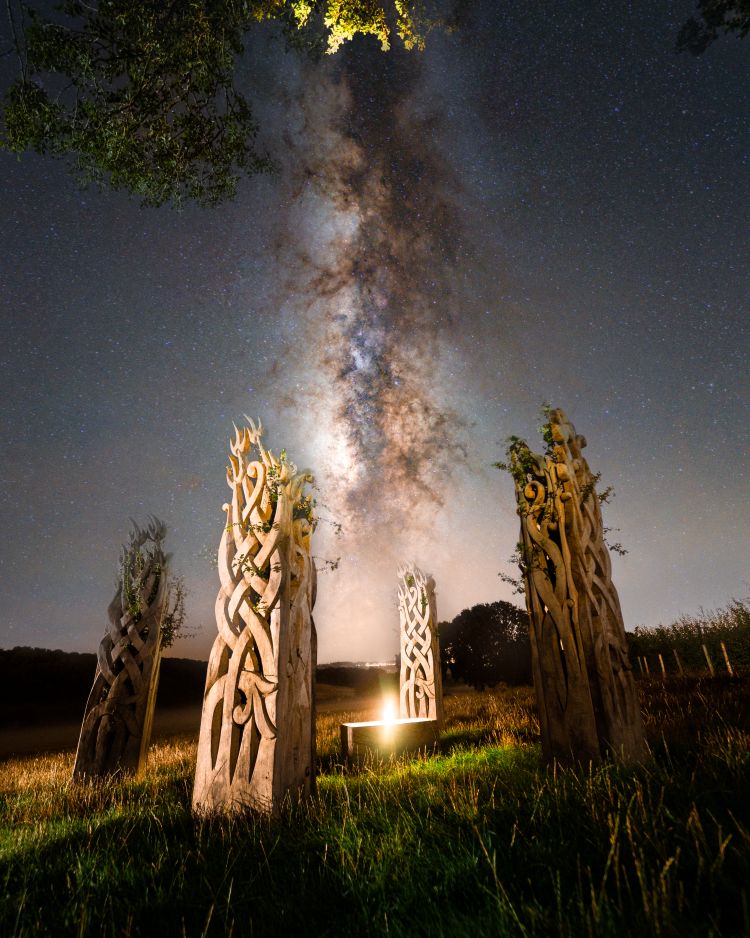
Photo by Geoff Frost
@the_overweight_photographer
Our black coffee grows cold on the workbench as we weave through the forest of torsos, to examine Pettit’s woodcuts, which have drawn my eye across the room. Here, the giant Pettit works in a micro-world, playing with the elusive nature of light in the most rigorous and precise of mediums. How does this detailed work marry up with his monumental sculptures? It was his fascination with words which led him here, he says. Given an illustrated edition of Rudyard Kipling’s Sussex poetry by a former partner in the early 90s, Pettit came across wood engraving for the first time. He was smitten. A particular woodcut of a classic Sussex ‘hollow way’ illustrated Kipling’s 1910 poem The Way Through the Woods: ‘They shut the road through the woods/ Seventy years ago./ Weather and rain have undone it again,/ And now you would never know/ There was once a road through the woods/ Before they planted the trees./ It is underneath the coppice and heath,/ And the thin anemones./ Only the keeper sees/ That, where the ring-dove broods,/ And the badgers roll at ease,/ There was once a road through the woods…’
“I love that poem,” says Pettit. “And around the same time, this woman from Ripe commissioned me to write a house sign for her – I’ve never stopped doing signwriting and letter carving, for the cash it brings in – and she asked me to copy a favourite woodcut she brought in, to go on the sign. I said, is that a wood engraving? How do you do that?”
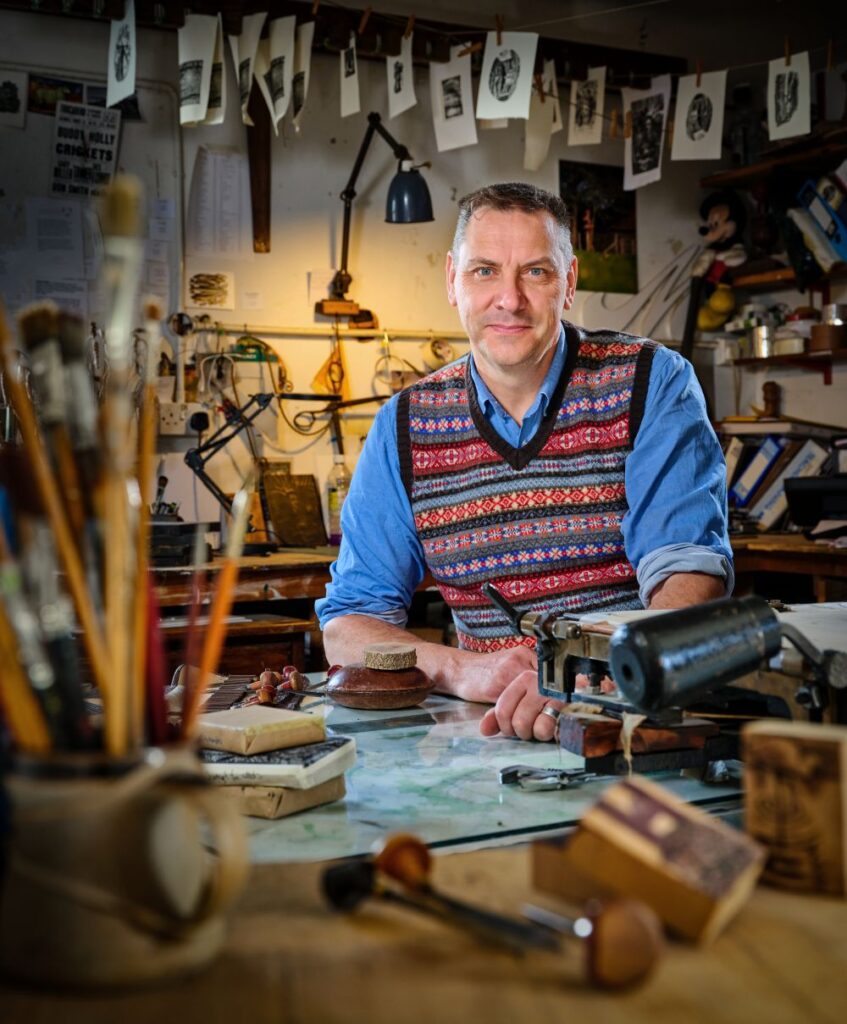
Photo by jimholden.co.uk
By chance, the woman had a neighbour who was giving lessons at The Paddock in Lewes. A couple of calls later and suddenly Keith found himself turning up at 7.30 on the following Tuesday evening. “This wonderful teacher called Diana Bloomfield spent ten minutes showing me the tools and what you did, gave me a block and sat me in a corner to get on with it.” The love affair began.
He shows me the print made from that first block. It is an exquisite, tiny world of tree and field and furrow, loosely done. “It’s not often you find you can just do something – I was able to translate images into the wood.” But now of course, he is challenging himself again, to be better. The relentless path. He didn’t just want to be derivative, to ape the rural tradition of woodcuts.
“I’ve pushed and pushed my thinking and I find it’s light I’m trying to describe. I want to share that spiritual moment when you are outside in the moonlight on a winter’s night. I’ve always been drawn to lens-flare in photography, when you face the camera into the light. It creates a parallel universe and I love that. It’s fairyland, potentially.” He is also intrigued by the halo around the moon, which in Sussex dialect, he tells me, was called the ‘shay’. “Looking at light, I started being kinder to myself,” he says. “Instead of feeling frustration when I make a mistake, I’ve worked out how to look at my work critically and learn from it.”
Pettit demonstrates by showing me a cut he’s proud of from one of his moonlit engravings, where the moonlight is unquestionably moonlight, even though you know it’s a cut made by a tool held by a man on a block of wood. This is a man obsessed. The cut is a millimetre wide and half a centimetre long. But I see exactly what he means.
Lost in thought, he thinks out loud. “I’ve been too fixed on bright light and deep shadow, now I’ve become interested in forming more of a misty, moody light.” Then, returning to me, he adds: “It’s no different to the Bonfire sculptures. They’re addictive because you’re faced by this massive challenge and loads of people doubt what you do, but you pull it off.”
Once his Bonfire sculpture of Nike is completed, and then summarily destroyed by flames, he will return to focusing on capturing the light. “I know ruralism is not fashionable, nor is white middle-aged men’s art. I’m up a bit of a cul-de-sac. But there’s nothing I can do about that – it’s who I am.” It’s hard selling work in the current climate, and there are bills to pay, but, says Keith Pettit, “I’ve got no alternative. The pursuit of this endeavour confounds sensible thinking. But I’ve made my bed. Even if I found a way to get out of it, I wouldn’t. It is what I do.”