
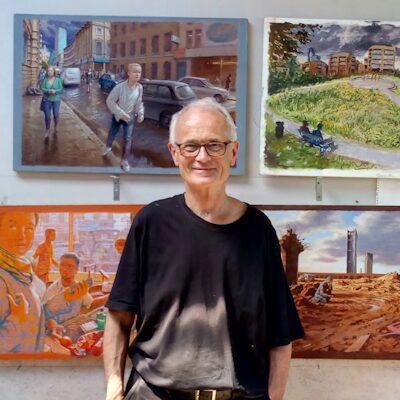
Imogen Lycett Green meets the painter and art critic.
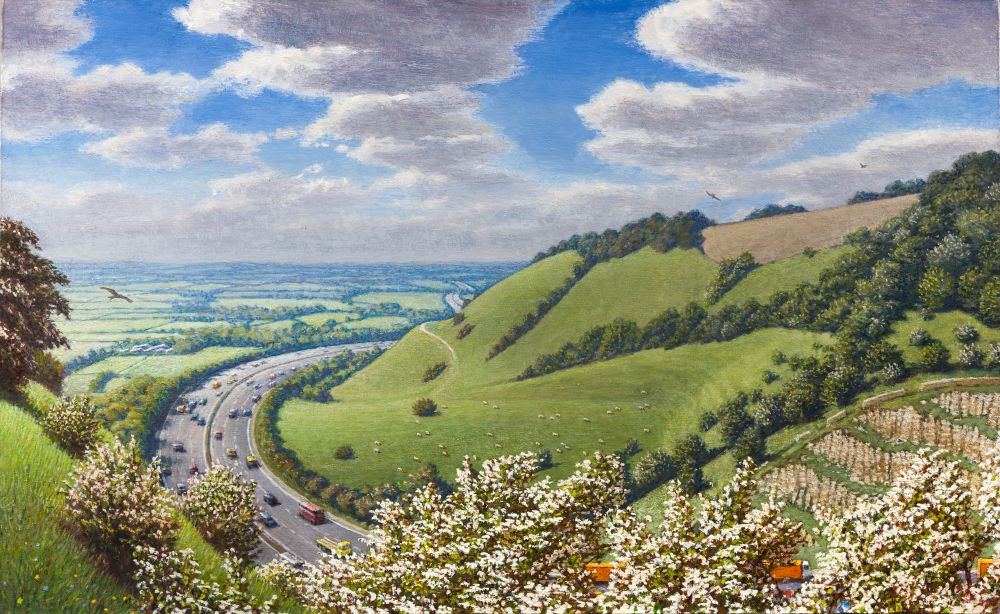
Oil on canvas, 26 x 42in
Not only is Julian Bell a proper painter, he’s a proper writer too. Before meeting him, I make the mistake of reading some of his articles in the London Review of Books, and find myself daunted by his intellectual range. He knows everything about art history, from Stonehenge to Sean Scully. How will I begin to talk to him about his own work? Then I attend a Brighton Pavilion talk about colour that he gives with two other Lewes-based artists, his friends Jo Lamb and Peter Messer. On stage, he describes his passion for paint shops as he discusses Red Madder (‘the colour of the heart, its emotion’) and Lapis Lazuli Blue, (‘the magic of blue is that the pigment is sourced beneath rocks in Afghanistan, yet on canvas, it is used to describe the sea and the sky’). I see a way in: I can talk to Julian Bell about shopping!
“The one kind of shopping I like is at Jacksons under the arches at Putney Bridge Station. You go through a tiny little doorway into what could be an illegal den of quiet small rooms with all the oil paint ranges in the world.” Bell sighs with pleasure and sips his tea. We are now in his studio, sitting on metal chairs, balancing our mugs on a makeshift table made of a wobbly board. This structure tips towards him, then towards me, like a seesaw, which breaks the ice somewhat. His huge studio, shared with other artists in a warehouse on a farm near Lewes, is organised but crowded with paint splatters and jam jars of brushes and a huge palette of drying colours. A black and white communal cat wanders in, the walls are hung with photographs and lists written in charcoal – he writes in that forward-sloping, elegant artist’s hand. We are surrounded by canvases, finished ones facing the wall, unfinished ones awaiting further consideration.
“It’s mostly unsellable,” he winces, smiling. Why’s that? “Figures,” he says. “I love painting figures in a landscape. I paint big but on a domestic scale – people generally would like to be taken out from their circumstances rather than planted in their circumstances in a more complicated way – and a figure tends to bring that process in its wake.”
Together, we contemplate his painting of a party of people late at night on a rooftop in London, the figures lit with a greenish light that emanates from the interior of a bar. At the heart of the painting is a man pulling away from a woman. What is it about? “It started off with me thinking about Brexit – but I was thinking about the whole thing in amorous terms. Okay, so you’ve got hitched to some nice woman and someone says why don’t you divorce her and come off with me, and there are various reasons why not and blah di blah, what a stupid thing to do etc. Then there’s setting the scene, endless sketches, models, an imaginary roof bar on the South Bank, and then it ended up with the great discovery of this particular green paint.” So this is how he works! “Painting, to my mind, is absolutely not ‘saying something’, except perhaps religious paintings, but even then… Communicating in that way requires a response. A painting is an offering. There are many possible takeaways and what you as a viewer take from any painting changes depending on how you are feeling, your emotional or environmental landscape, your cultural cues.” What’s the green called? With childish delight, he says, “It’s Gambolling Radiant Green!”
Bell’s new show will be called England Road. He does paint landscapes, rivers and the leaves on the trees, but within the natural beauty of England is a network of motorways and ferries, traffic lights and trucks. “This is how Britain is now,” he says. “It is untruthful to paint it any other way.” His painting of the famous cut through the Chiltern hills where the M40 leaves the hills of Buckinghamshire to descend onto the Oxford plain, is ripped through by the motorway dotted with Dinky-sized cars in red and orange. “Oh that’s where you see the red kites,” I say. “Should I put kites in?” he wonders. Hand on chin, he ponders the painting.
After 50 years at the easel, is he better at making these kind of decisions about composition and colour? “I am better – for instance I spent lockdown looking at trees and I paint trees with more depth and understanding than before – but I don’t think making work gets simpler. Once a month I meet my painter mates in the Lewes Arms – I paint with oil, Peter works in egg tempera and Jo paints in acrylic, so we can swap notes without feeling rivalrous – and we moan together. You have an improved technique, a knack, but then, have you lost a certain crude fire – the urgency of youth?”
The urgent, youthful Bell was brought up in Leeds, where his father Quentin Bell, Clive and Vanessa Bell’s son, was a university lecturer. But in 1967, when Julian was 15, Quentin came home to the Bloomsbury fold, taking a sabbatical to write a book about his aunt, Virginia Woolf, and brought the whole family – Julian, his mother Olivier and his sisters, Virginia and Cressida – to live in a house near Charleston. “Coming from Leeds to Sussex, I was moody and getting moodier – that’s when I put away my toy soldiers and started painting.” There was the equipment, he says, and it was possible. “But I had a forbearing and faintly sceptical dad who said ‘I don’t think you’re a born painter’.” So Julian studied English literature at Oxford instead of going to art school. “But I’m not a born academic either,” he says.
But you were born into writing and painting, I say. “On both sides,” says Bell. “I love Vanessa [who died when he was eight] and I love Quentin, but I probably cleave more to my maternal side.” Bell’s maternal grandfather Arthur Popham was a scholar of Italian prints and drawings who worked at the British Museum and introduced Julian to Bruegel. “I didn’t go to Vienna to see the real thing till much later in life, but as a child I looked endlessly at colour reproductions of Bruegel’s paintings of everything happening in the world. His work gave me a yen for the panoramic – looking at all kinds of stuff with a broad perspective. I had impulses to make experience manageable – that’s absolutely a motive that goes into being this sort of painter. Perhaps it is an emotional compensation mechanism.” He pauses, hand to chin again. “Everything is after all a substitute for something else. Plus you can see the fun Bruegel has in making every sort of thing – be it a tree, a peasant, a cow, be it anything in the world.”
I can see Bruegel’s influence in Bell’s work. So many of his paintings are from a bird’s eye view. Another influence was his mother’s first love, Graham Bell [no relation], a South African painter who came to England from Natal in the 1930s. “If you came to my flat [in Lewes where he lives after his wife died two years ago] you’d see many of Graham’s paintings that my mother had. Graham Bell fell out with the wife he arrived with, and fell in with this high-minded young woman who was my mother [Anne Olivier Popham, referred to as ‘Olivier’].” The couple lived together in London, but when the war came Graham Bell joined the RAF and was killed in an air training accident in 1943. “What a stupid waste. Graham Bell is not well known because his career was short, but he had a beautiful subtlety and sensibility and his paintings are touchstones for me.”
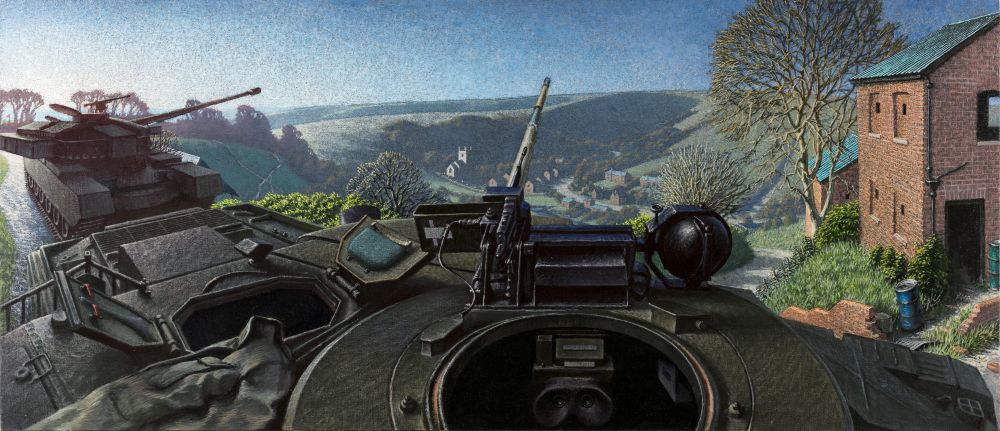
Oil on canvas, 29 x 69in
So his mother loved two Bells? Julian describes his parents’ marriage: “We were a stiff-upper-lip family, relatively weird and my parents were older than everyone at the school gate. The morning after Quentin died, we were having breakfast, and Olivier said quietly: “It was a good marriage.” On with the toast and marmalade! “It was a rational arrangement between a 42-year-old and 36-year-old. They were absolutely devoted and good collaborators. He could generate lots of high spirited and amusing writing of great insight, and Olivier – who was a scholar and methodical – could check it for facts. It was an essential relationship, as they both realised, but also exasperating!”
His mother’s family were also moderately religious whereas the Bloomsbury lot were anti-religion. Is he a churchgoer? “I go to Subud in Lewes,” Julian explains, citing the Quaker like simplicity and democracy of the international spiritual movement (founded in Indonesia in the 1920s with about 10,000 members worldwide) as a quiet backbone to his life.
Even so, the gods did not smile kindly on him when all his work was destroyed in a fire in the Phoenix Studios in Lewes on March 29, 2014. “Everything I owned disappeared. It was an old industrial building and someone had a wood-burning stove where the casing had slipped and my studio was on the second floor.” The fire started at 6pm and by twenty past six the flames were huge; when the fire engines arrived they could do nothing. “If I had got there at five past six I might have run up the stairs to save my paintings, but then I’d probably be dead.” He and the other artists who had lost their work and livelihoods, watched the fire in shock, then repaired to nearby pub The Lamb, heads in their hands, where the landlord gave them free drinks.
But isn’t it always the case that destruction and creation go hand in hand? This show, ten years on, is Bell’s phoenix rising from the flames. To aid him with planning it, he has built here in his studio a Lilliputian model of the many-roomed gallery in London where he will show his paintings: some new and some repainted from memory after the fire. The model is intricate, with little named rectangles stuck on where each painting will hang. Here is another small, manageable world. I notice the little toy cars on a shelf, replicas of which, like the orange van, appear in his painting of the Blackwall Tunnel, and I half feel like vroom-vrooming the tiny vehicles up to the door of the model gallery. For being with Julian Bell is an invitation to play as well as an invitation to think. Dressed in his workman’s uniform of black t-shirt, black jeans and Doc Martens, Bell is up and down like a yo-yo, gesticulating like an Italian. Despite his grey hair and round glasses, it’s easy to describe the angular, fidgety Bell as childlike. “Everyone patronises me,” he wails, laughing, “even my children [he has two daughters and a son] and my two younger sisters.”
Bell trots his fingers down the stairs of the model to the basement where more work will hang. The show is in Soho, “between the fleshpots and the nightclubs, where I like to be,” says Bell, mischief in his eyes. “I need my London fix,” he says, “despite the rural straw in my hair.” He teaches at the Royal Drawing School and loves to walk around London, and for this show, alongside the big canvases, he is also working on a new series of 14 small paintings of the urban landscape around Bloomsbury, on wood. With figures. He shows me the sketches on tracing paper, all stuck with Sellotape onto rather smart mahogany boards. It turns out the boards are pieces of a wardrobe he destroyed. “It was a Victorian tallboy, a family heirloom, and nobody wanted it, not my children nor Cressida or Virginia, so I took an axe to it.” Oh, the perfect story: Julian Bell takes axe to family history, paints new stories over the old! It was a Charleston heirloom, I pray. Alas not, he says, it’s from his late wife’s family, but as a writer, he appreciates the better story, and says I can pretend it is a Bloomsbury relic.
Another Bloomsbury legend beckons, but I find I do not want to pretend. Julian Bell is not a myth, but here, and real. Though there is, of course, another Julian Bell, whom this Julian calls – only half joking – the real Julian Bell: Vanessa Bell’s son Julian Heward Bell, who died in the Spanish Civil War aged 29. The Julian I’m talking to was aware “for as long as I can remember” that he was named after a dead uncle. “He and Quentin were thick as thieves – being horrid to governesses together, f ighting with each other. There is a nice American academic who wrote a book about him, and it tells a rather sad story to me, because Julian was the first child of all those Bloomsburies, bang in the centre of the circle, and all the weight of what the next generation was to be lay on his shoulders. Aunt Virginia worried about him, everyone fussed over him, painted him. He went up to Cambridge as the Bloomsburies had, and there he found himself the child of avant garde people in the run up to the Great War, and both he and Quentin reacted in a Post-Modern way to the Modernists who’d been their parents.” After failing to secure a preferment at Cambridge, Julian went to teach English in China and when he came back after three years, went to fight in Spain. Three weeks later he was dead. The Julian I’m talking to says, “His death wrecked Vanessa, I believe. But apparently, he was really happy for those three weeks, finally he had a sense of purpose. I’m glad about that.”
And I’m glad that this Julian has not buckled under the weight of expectation, but is able to nod back and look forward simultaneously, and with purpose. He says ‘after’ with a flat ‘a’, a hangover from Leeds, yet otherwise his pronunciation screams Oxbridge; he is tied by his umbilical cord to the Bloomsburies, as he calls them, but his England has the Amazon Warehouse beside the oak; he has been hollowed out by loss, but finds beauty in everyday things. Julian Bell paints his own thing in his own way and does not flinch from the truth.
One of the paintings lost in the fire that he has re-painted is called Exercises at Imber. He first painted it in 2004, in response to the Iraq war. The new painting is as powerful, beautiful and moving an anti-war painting as any I have seen, more relevant this day than then. On Salisbury Plain in WW2, the army evacuated whole villages to use them for training. Imber is one such village, and in Bell’s painting, the rural idyll plays backdrop to two monster tanks which dominate the foreground. Preparing to paint, Bell spent time sketching at the Tank Museum and joshing with former squaddies in charge of these beasts. Yet in the Seurat-like pointillism of his fields, church and trees, Bell generates a folkloric echo, connecting with a lost past as well as with painters like David Inshaw and Annie Ovendon, members of the Brotherhood of Ruralists who painted in Somerset in the 1970s. That’s about as ‘art history’ as I’m going to get in this piece. But I need not have worried. I’m relieved when Julian says: “I can’t bear artists’ statements – though my God I’ve written some in my time – with all those polysyllabic words. Like polysyllabic!” Let’s just say his work is good: playful sometimes, serious at others, intense and intellectual but full of joy. When he paints a ferry on the Mersey, he paints it lovingly. The same with tanks. What do they say in films – you hit the jackpot when you make people laugh and cry at the same time? Julian Bell’s work is kind of like that. I predict that all of it will sell.
England Road: New Paintings by Julian Bell is presented by Natasha O’Kane Sussex Contemporary Art at 15 Bateman Street, Soho, London W1D 3AQ. October 14-19. Private View: October 14, 5-8pm.