
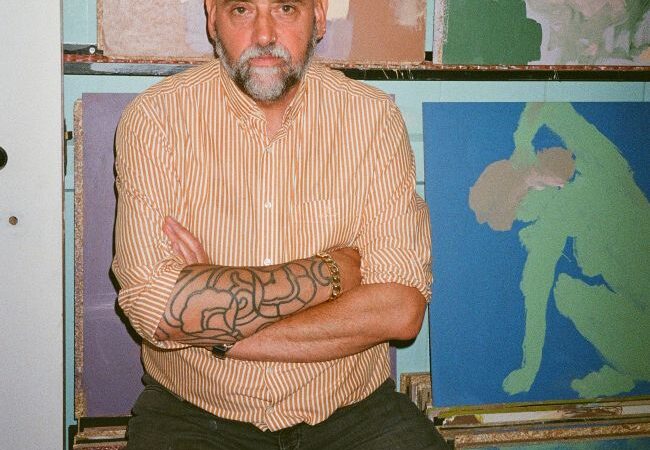
Henry Bond, painter, collector, retired YBA photographer.
As a Goldsmiths alumnus and former YBA, your name is strongly associated with London. Why and when did you move to Sussex?
I came on a weekend trip to Hastings just after Christmas in 2023, after my divorce. And I liked it so much, I extended the weekend to go on property viewings. Within a week I’d found a flat to rent on the seafront. It really suited me, so in May 2024 I bought it off the landlady.
So are you up and down to London?
Not at all. I was born in London and I’m a Londoner, but it sucked so much out of me that I’m due some respite. I’ve made a clean break with the city for psychological reasons. London has changed so much in the last 40 years, everything is always overcrowded and I don’t want to live at the pace you have to live there. Whenever I got a train up, when the outskirts started appearing my stomach dropped. When I used the Tube I thought ‘what am I doing on this sickening train, nearly fainting?’ So I don’t go any more, and I won’t go anymore, unless I’m summonsed for a court appearance or something like that.
How do you spend your time in Hastings?
I’ve retired as a photography tutor at Kingston University, and I’ve retired as a photographer. So I go shopping, I go walking on the seafront, I go and see friends. A year ago I started collecting paintings by artists from this area, so I go to private views and on studio visits. And last Christmas I took up painting myself.
Tell us about your art practice.
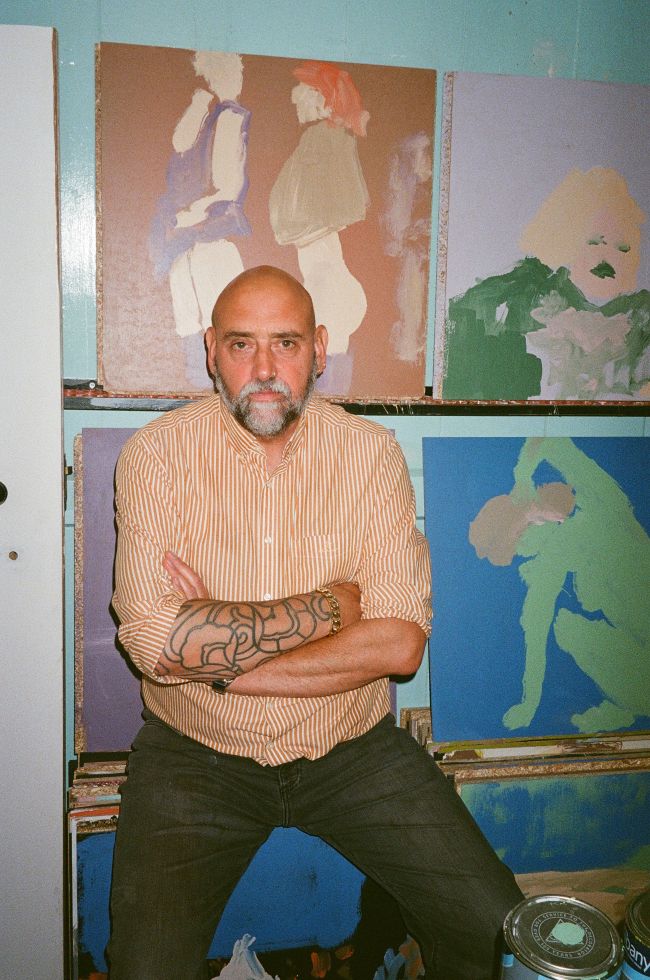
It’s highly ritualised. Every night I prime two pieces of chipboard, always the same size, 60 by 60 cms. The next morning, first thing, still under the influence of the dream state, I paint for ten to twenty minutes, to a set jazz soundtrack, buzzing from the effect of an extremely strong cup of coffee, producing two or three paintings, after which I’m completely burnt out. My source material is 34 images of Impressionist paintings I’ve cut out of books and magazines, which I rework in my own, uninhibited style. Every month Elle Decoration magazine selects eight colour swatches they reckon are hot, so every month I go to Brewers and buy eight pots of matt vinyl emulsion in those colours, and that’s my palette until the next edition comes out. Not because the colours are trendy, that’s nonsense, but to give my palette a change. If I like the paintings, which I generally do, I keep them, if I don’t I paint over them and take them to the dump. The paintings I keep are for sale, and they are all priced the same: £2,400. I’ve been helped enormously by occasional one-to-one tuition from The Baron Gilvan, my mentor and a painter I admire (I have one of his pieces in my collection).
Tell us about your collecting.
I found a nautical chart in a junk shop, spanning the ‘536’ area of the south coast from Newhaven to Dungeness. Those are my parameters: I only buy work from artists who are based in towns or villages on that map. My ballpark price is 500-1000 quid, and I base my choices on excellence rather than any particular artistic orientation. I visit studios and go to a lot of exhibition private views: I always make sure I’m the first person through the door, but I can always buy the stand-out piece because I find there isn’t much competition. There aren’t many serious collectors round here, just as there aren’t many serious art dealers who represent artists in the way London dealers do. But the number of talented artists living in this little 20-to-30-mile stretch is extraordinary. There’s a mindset here that produces a lot of unconventional people who are well-versed in critical thinking. I’ve reached the end of phase one of my collecting, because the walls of my house are full. Phase two will be finding a public space to show the work, in Hastings or St Leonards.
When did you realise that East Sussex was such a hotbed of artistic talent?
In London, the word ‘provincial’ is one of the ultimate put downs, and there’s this myth that there’s a big divide between the raw cutting-edge of London and the lacklustre artists in the provinces. I used to believe in that myth, but my year of collecting has changed my mind forever: it’s nonsense, complete nonsense.
You’ve got a daily art practice and a busy collection procedure: why do you say you’ve retired?
I don’t see my painting as a career. I mean the Goldsmiths way was all about hustling. You knock on doors, you put on exhibitions. You don’t wait for the kind of lazy, long-lunch art dealers to come and find you, because they never will. That’s what we were taught. Don’t ask, don’t get. And I’ve done that. I was hustling up a career for 40 years. I’m not doing it like that anymore.
Do you travel round Sussex much?
I’ve never learnt to drive, but I get about the place on the train and on my bicycle. My girlfriend Nicola lives in Cooksbridge, so I often go there, as well as Lewes and Eastbourne and Bexhill. But most of my needs are met in Hastings and St Leonards. The Kino Teatr is what an art centre should be, like the ICA used to be to London 30 years ago. You can be fed and watered: they make great Negronis. You can see some art, you can see a film, you could potentially go to the theatre in the evening.
Can you recommend a good restaurant?
BAYTE is the best restaurant in town, on the Kings Road in St Leonards. I can’t recommend it highly enough. If you think you know everything there is to know about Italian food, think again, they are always doing research and coming up with rare recipes.
When did you last swim in the sea?
I’m a kayak man, and I might one day become a paddleboard man. So I go on the sea rather than in the sea. Unfortunately, one of the drawbacks of Hastings is the poor water quality caused by the Victorian sewage system.
If you were exiled from Hastings, where would you like to live?
St Leonards.