
Our secret buyer on art in the Romantic tradition
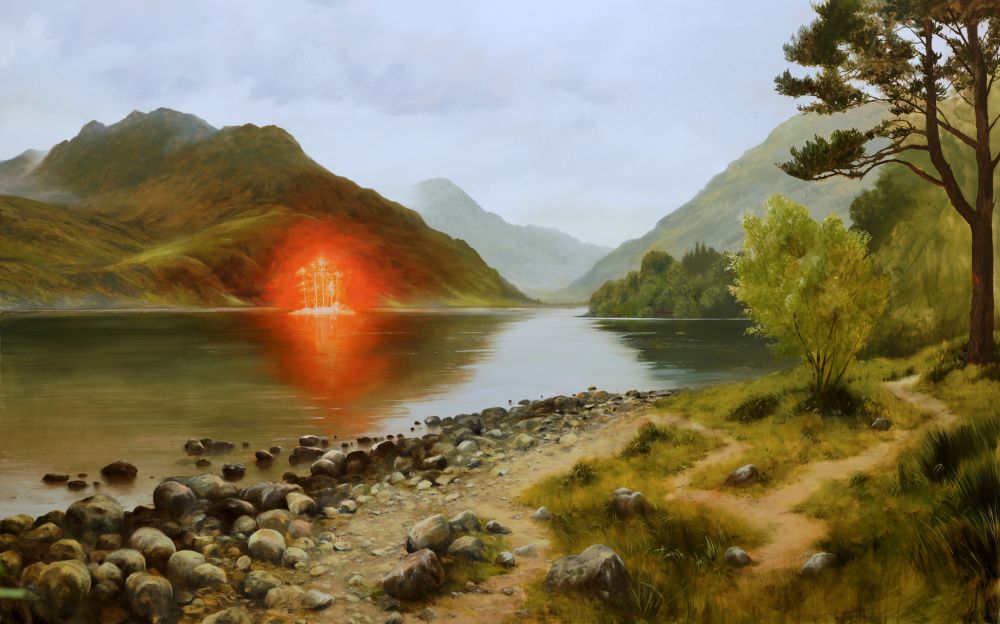
A Friend From Another Star, 2025-26
Oil on linen, 230 x 140cm
When we describe any art form – whether visual art, music or literature – as ‘Romantic’, what do we mean? No single definition can be distilled from the large volume of work, much of it produced in the 19th century, which goes by that name. Its various uses should be displayed in a Venn diagram, capturing a range of different, overlapping and sometimes inconsistent meanings.
The outstanding exhibition of the art of Turner and Constable at Tate Britain, running until April 12, gives a very English interpretation. Turner and Constable’s achievements differ in many ways, but they both made two innovations of great significance: the development of watercolour, previously regarded as a lesser and genteel medium, into a means of powerful expression; and, influenced by Claude Lorrain, the presentation of natural landscape as a subject in itself, emancipated from its earlier role as decorative background to figurative subjects. The contemplation of landscape in its own right – paralleled in the poetics of their contemporary, Wordsworth – lay at the core of one version of the Romantic.
While the genius and scale of Turner’s and Constable’s masterworks placed them beyond the reach of all but the wealthiest patrons – and are now almost entirely consigned to museums – they unleashed a large body of work by other British artists who adopted their subject and medium. So-called Romantic landscapes, some in oil but many in watercolour, took over the world of Victorian art. Much of it is on sale today.
John Holmes, head of fine art at auctioneers Gorringe’s, describes a difficult market for the collector in this field. Too many Victorian landscapes, and there are many of them, are bland renderings of the land and figures in front of the artist’s easel. They can lack any emotional charge or imagination. Pieces from that period possessing the vision and power required to rank as true heirs to the Romantic ideals of Constable are rare.
A different view of the Romantic was developed by the Pre Raphaelites, inspired by medieval ‘romances’. Work in that style is also rare, for a different reason. Because of the demanding technical skill and historical knowledge invested in its production, the tradition had fewer practitioners. Illustrated here is an excellent example of the genre shortly to be auctioned by Gorringe’s (March 10), executed by one of that exclusive clan, Lucy Madox Brown, daughter of Ford Madox Ford, married to a Rossetti.
Some collectors turn to the accomplished work of post-modern contemporary artists maintaining the landscape tradition. Like Samuel Palmer (Shoreham, Kent), Constable himself (the Stour Valley), Graham Sutherland (the Gower Peninsula) and Paul Nash and Eric Ravilious (the South Downs), they identify with and immerse themselves in the special character of a particular location. A recent visit to London Art Fair has revealed two outstanding examples.
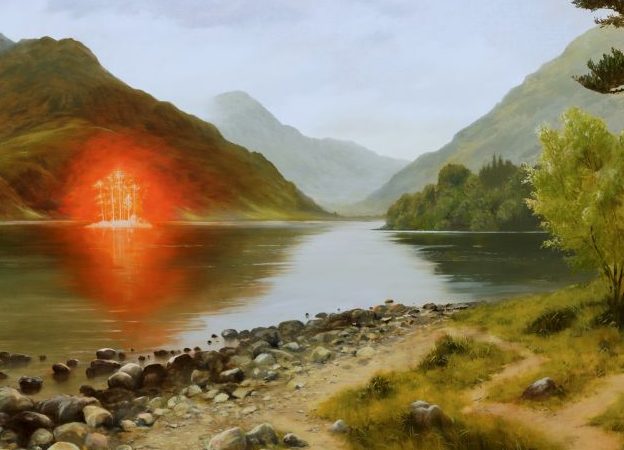
Andrew McIntosh (represented by James Freeman) can, among his other skills, render the Scottish landscape in the German Romantic manner of Caspar David Friedrich. But there is always a startling intrusion: a coppice of trees ablaze on the lake’s far bank, a dilapidated caravan (a favourite image) oddly placed, uncanny lights. In one image we see the archetypical tree, presented repeatedly in Turner’s and Constable’s landscapes, disturbingly set in bloodily veined roots. He revels in dissonances compelling constant re-assessment of the familiar.
Simon Palmer (represented by Portland Gallery) rarely leaves his native Yorkshire. Working in watercolour with ink and gouache he invests hills, dales, woodland and natural objects with poetry and mystery in the unaffected natural style advocated by Constable and, in his poetry, by Wordsworth. Roads and paths sinuously twist and turn, leading both eye and imagination out of the picture frame into another imagined space. Road signs (‘Give Way’) and road markings (‘Slow’) wittily intrude. There is nothing inert in this seemingly tranquil land.
Julian Bell, the admired Sussex artist and an esteemed art critic and author, also introduces modern elements into his landscapes, bringing the genre firmly into the 21st century. Bell, grandson of Vanessa Bell, is represented by Natasha O’Kane. Lucy Marks ROI literally follows in the footsteps of both Constable and Turner. She created a recent series painted in the exact locations Constable depicted on his working walks in the Sussex Downs. And Marks was recently chosen to respond to Turner’s Petworth Park: Tillington Church in the Distance with a piece which was hung alongside its inspiration in the Petworth House exhibition Turner’s Vision. Modern Romance? Look hard and you will find.