
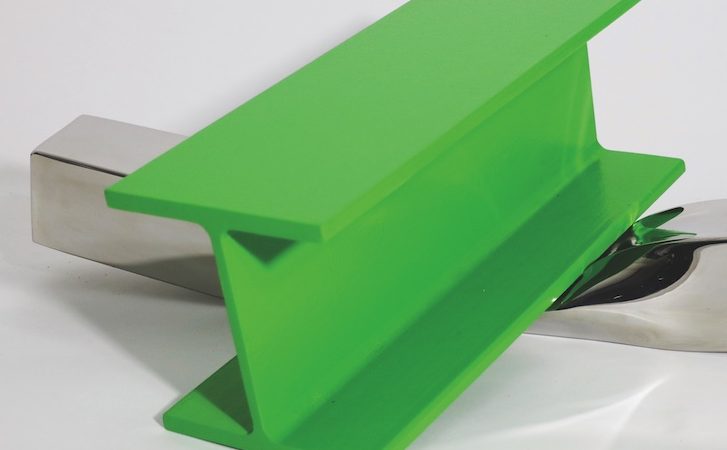
Imogen Lycett Green meets Newhaven-based sculptor Julian Wild

and stainless steel, 220x120x120cm
Photo by Noah Dacosta
I’m at home with sculptor Julian Wild in the Victorian terraced house in Newhaven that he shares with his partner, the painter Alison Hand, and the couple’s melded brood of three teenage boys. The boys are at school, so the house is quiet. Too quiet. We three adults bunch around the kettle and navigate the early moments of our acquaintance by talking about coffee – how do you take it? – and paint colours.
“It’s Cerulean blue, isn’t it?” says Julian, looking at Alison for confirmation. The house is a work in progress, and we’re staring at the single wall they’ve painted as a backdrop for Zoom meetings. “So we look together,” says Julian. He means ‘organised’, but my thoughts jump directly to his and Alison’s togetherness, mesmerised as I am already by this partnership, creative and romantic.
But I’m here to interview Julian! Alison says she is going to head on to the studio where they both work. “Stay!” says Julian. “Stay!” I say. But Alison goes, keen to get painting.
So Julian and I sit down in the front room, where a black- and-white cat called Charles stalks about like a cartoon cat, looking for trouble. There are tall glass display cabinets filled with ceramics and glassware from the 1950s and 1960s, in blue and green and orange. Charles picks his way across Julian’s desk, where there is an intriguing ceramic sculpture of glazed orange clay folded and layered into a… into a what? A deeply satisfying, organic thing, like an Escher drawing made 3D, the size of a human head. “Oh, that,” says Julian Wild. “I did it years ago. 2007? I called it ‘Tangerine’, which is the colour of the glaze.”
I want to embrace ‘Tangerine’, to hold it. I want it on my own desk. Even if it’s orange. Especially because it’s orange. There is a form and balance to it which is immensely satisfying. Like, well, an orange. There is a lot of orange in the room, I realise. This makes sense when Julian tells me orange was his favourite colour as a child. Which is kind of exotic – doesn’t everyone choose red, yellow or blue? – but then again, his childhood wasn’t that conventional.
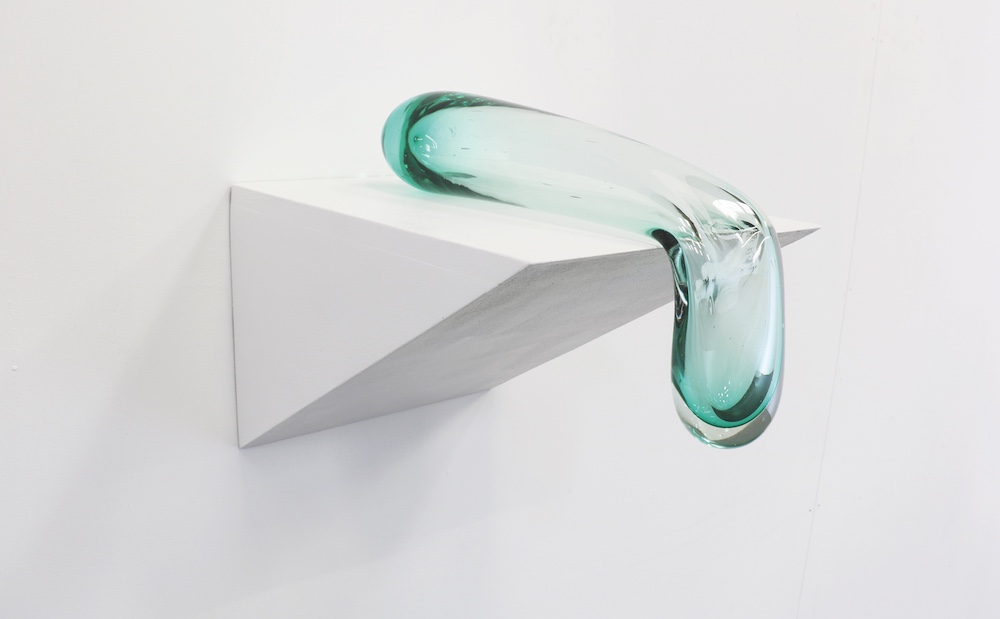
glass and painted MDF, 24x24x32cm
Photo by Julian Wild
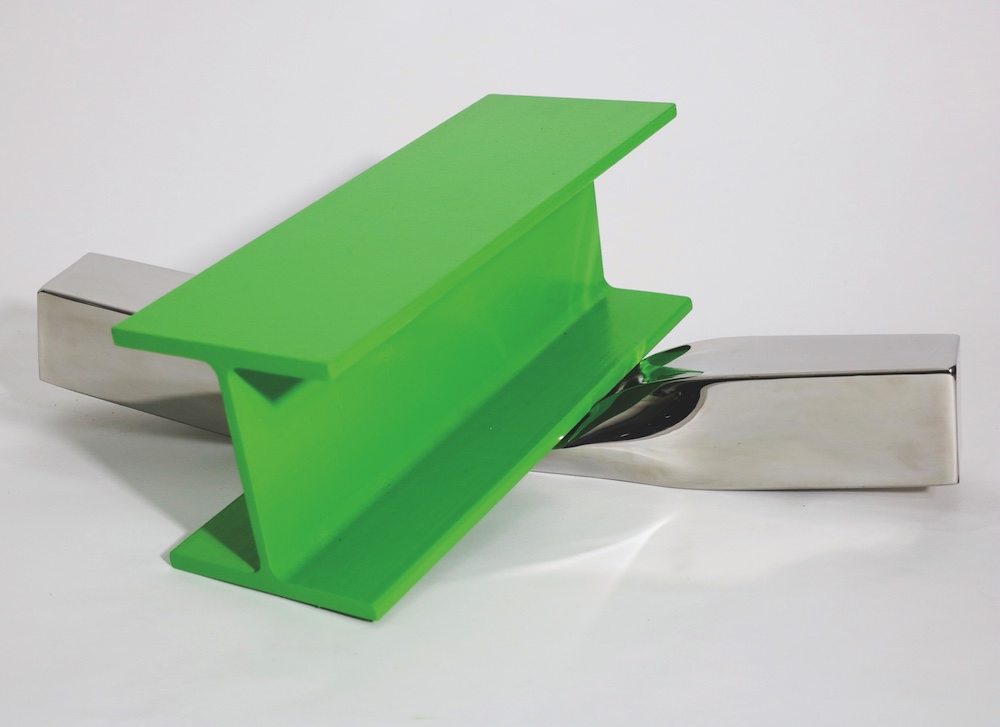
and stainless steel, 25x65x42cm
For one, he was always on the move, because his father’s job at IBM took the family – Wild has a sister and a brother – around the houses, from Munich, where he went to nursery school (“I spent my first four years speaking German”), via Surrey, which he didn’t like at all, probably because his artistic, antique-dealer mother found it uninteresting, to Chipping Norton, in the Cotswolds, “which in the early 80s was a broken-down town with a derelict tweed mill at its heart”. He was sent young to boarding school (where he was the odd one out and quickly developed strategies to avoid bullies and worse), and it was only on an art foundation course in Cheltenham in the early 90s that he began to discover who he was and make real friends. “The culture just grabbed me,” he says. “It was all about making something out of nothing.” Two teachers in particular inspired him with their belief in freedom of expression: “You could make anything you wanted with whatever material you chose.”
The training he received has fed into his own passion for teaching, and after nine years at the Art Academy London, where he and Alison Hand met and where Alison still teaches, the two artists have founded their own art school in Newhaven. Cement Arts runs courses for professionals and beginners in anything and everything, from metal sculpture to ceramics to silicone mould-making and oil and acrylic painting. “I like the openness of possibility.”
But what of his own practice? I’m so intrigued by the house and childhood stories that I’ve forgotten we’re here to talk about art. Wild’s artist statements are full of opposing forces, like repression and rebellion, growth and restriction. I’m beginning to get a sense of where this energy comes from, but our conversation is charging about like an unmanned speedboat, from colour to college, to banana plants (he wants one in their garden), to 50s music (his favourite), to Damien Hirst, for whom Julian worked as a studio assistant after art college. So I’m glad when Julian suggests we go to the studio.
On the five-minute walk, we stop to watch an enormous dredger ship with an orange arm leaving the port. The foghorn sounds, signalling the elemental simplicity of sea travel. It’s like a scene from Richard Scarry, I say – with the boats and trucks and primary colours and piles of scree. “You know Richard Scarry!” says Julian. “That’s exactly how I see it!” Scarry is a children’s author who depicted cats and pigs and bears, called Pig Will and Pig Won’t and Huckle Cat and Miss Honey, working in Busytown as policemen and teachers and postmen, watched from the side by Lowly Worm. Alongside the enormous ship, a gig appears, rowed by members of the Newhaven Gig Rowing Club. This is Richard Scarry in real time. “They shouldn’t be that close,” says Julian, alarmed. We watch the rowers huffing and heaving until they clear the ship. There is so much going on.
On the one hand, Newhaven is a Richard Scarry child’s dreamland, replete with yellow diggers and blue bridges and orange boats, and on the other, it is home to a huge incinerator, which processes thousands and thousands of tonnes of Sussex waste per year. Fishing boats still sail out daily, their crews catching whiting, bass, cod and lemon sole for Sussex restaurants and fish and chips, and the ferry sails from here to Dieppe, but at the same time the local asphalt plant spews out chemical waste. Julian embraces this tension. With its mixture of steely industry and cartoon imagery, the harbour town suits him. Newhaven is also rapidly becoming an art hub – with Marine Workshops, the BN9 studio and Newhaven Art Space all flourishing within the Newhaven Enterprise Zone.
Wild’s studio is housed in an industrial warehouse on Quarry Road, set back from the clinking masts of the sailing club and the end-of-the-world (or certainly, end-of-the-quay) last- chance saloon, the Hope Inn, where Edward Bawden and Eric Ravilious stayed in 1935 on a painting trip. Bawden and Ravilious are long gone, but those familiar curvilinear paintings they made of the harbour and lighthouse remain vivid. Above us, seagulls hover like ghosts on the salt air.
“Of course it attracts artists,” says Julian. It’s a living, breathing, working town, unlike other Sussex towns still set in aspic, and there is light and energy here by the sea. “We’re making a community of artists here – I love conversation, I’m a social creature, I want to exchange ideas.” Several years working as front-of-house manager at the Saatchi Gallery when a young, developing artist, had him perfect the art of talking to strangers. He’s a trustee of the Chelsea Arts Club Trust, a past VP of the Royal Society of Sculptors, and has a growing audience on Instagram, where he posts films of himself working or at play (face-planting while wakeboarding off Newhaven Harbour, for instance).
In the studio, however, Wild is focused, unreachable, obsessive. To show me, he plays Busytown’s metalworker, wielding a metal torch, gesticulating as he explains the physics of welding. We wear visors, but still I duck from time to time. The insistent hum of the extractor and the smell of burning metal follow his line along the edge of an open, square-ended steel tube. He is working with a TIG welder, a mixture of gas and electricity firing out through the metal rod. Loudly over the noise, he explains, “There’s a foot pedal, so I can control how much power is going into the weld.” Sparks fly as he puts his foot down, joining a square metal plate onto the end of the steel tube that has already been squashed by a hydraulic press into a shape which is part design, part happenstance. This tube will join three other tubes, distorted, balancing, on sections of industrial steel I-beams. “There, done!” We remove our visors. Why do you want to close the ends of the tube, I wonder? “To make it dysfunctional,” he says. “As soon as the metal beam has no practical use, it becomes something else, takes on its own character.”
The creature-structure which this tube will join is both inanimate and animate, a shoulder-high tower of what looks like precariously balanced metal, somehow possessing human characteristics. “I think it’s me,” says Julian, staring hard at the sculpture, that is both teetering and secure, oppressed and released. “You start with an intention, but then it grows into itself and tells you who you are, or certainly, what you are thinking.” He will show this latest sculpture, as yet unnamed, in June this year with HS Projects in London, in a joint show – their first together – with Alison, who is working upstairs.
Downstairs, Julian and I examine metal rollers and bench grinders. One machine is a laundry mangle. Drills, saws and hammers are arranged neatly on a wall of hooks. Here is a veritable Victorian torture chamber where, with the turning of a lever, you can squash what can’t be squashed, subdue force or, indeed, force subjugation. “You know in cartoons when they drop safes and squash cats,” says Wild, recalling the cartoons of his childhood, like Road Runner and Tom & Jerry. “Then the cat emerges, shakes itself off and finds some way, through ingenuity and guile, to get back at the mouse. But you love both the aggressor and victim.”
“I love the impossibility of that – the unstoppable energy. I made a piece based on the Himalayan balsam seed pod – it’s called ‘Inside Out’ – this idea that this plant, which spreads up watercourses, has evolved to spring seed pods seven metres away. It’s a brilliant piece of natural engineering.” Wild is bright with boyish wonder. “I was useless at physics in school,” he says. “So I love to upend what people think is possible, to stretch the imagination, physically and visually.”
One way Julian does this is with colour. “People have said the reds and purples and yellows in my work are unnatural,” he says. “There is this thing in sculpture called ‘truth to material’, where people expect you to leave rusting metal rust-coloured, or stainless steel silvery. It is easy to make everything tone down and fit into the English weather and landscape, but I want to do the opposite. I want my work to stand out. Like pillar boxes and red phone boxes. People and things get lost in the landscape, so I’m constantly fighting with the environment to make the work stand out, or recede, or do different things. Look at azaleas and rhododendrons! You see these intense colours in nature that can be in a flower or bright green grass in spring. Yellow can be a JCB or ragwort or a sunflower.”

Photo by Rowena Easton
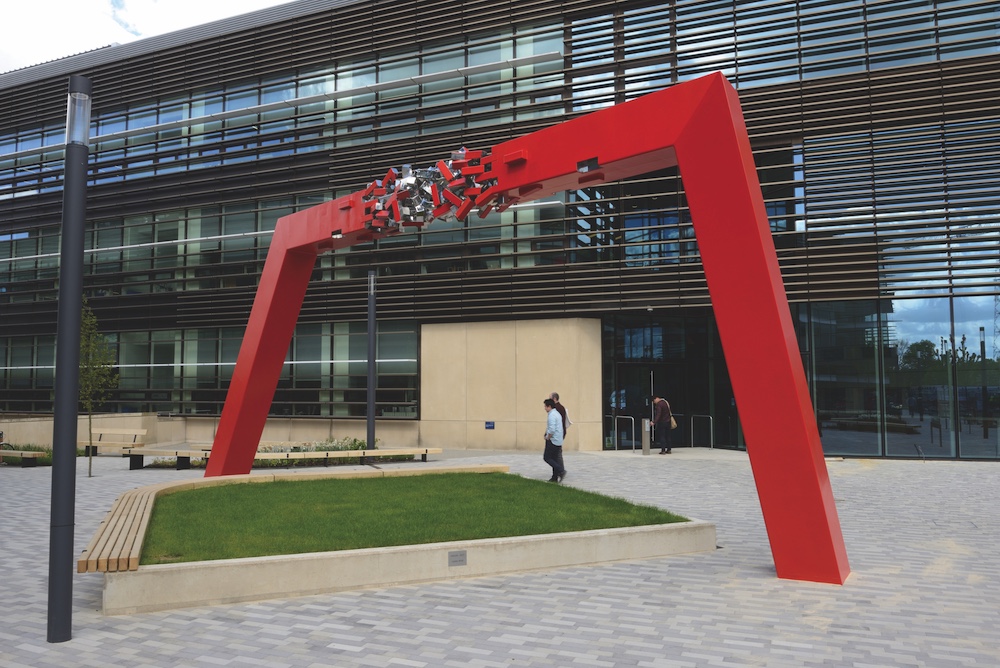
stainless steel, 600x350x1200cm
Commission for the University of
Oxford Big Data Institute
Photo by Anne-Katrin Purkiss
Julian uses the RAL colour-matching system that defines industrial colours for paint, coatings and plastics across the world. Just as he uses industrial colour charts, he cleaves towards industrial materials, the I-beam (a Victorian invention used for joists in building) being a consistent element in his sculptures. “I love its violent, industrial purpose.” At the same time, he’s fascinated by the control of nature. “When I was doing a show at Burghley House in Lincolnshire in 2011, I responded to Capability Brown and the idea of controlling and ordering nature. It’s insane – employing hundreds of people to dig out a lake, then to try and make it look natural. I’m probably the opposite of rewilding. I’m fascinated by yew cloud hedges and I like a bit of topiary.”
Ideas of control are threaded through his work. “I’m trying to describe a world that will make sense to my sons – versions of masculinity explored – the constant push-pull of repression and energy. I use the tools and machines to make sense or find a story in these clashing contradictions.” There is also the sense that he is making the monumental out of the everyday, using metal, wood, plastic and glass that is in our life already and transforming it into something unpredictable and lucid. His 2025 sculpture On the Edge (Aqua) is part of a recent series of glass pieces that are based on his longstanding fear of heights, a fear so great he can’t fly. But they’re humorous and human too – like organisms making a play to leave, to jump, to escape. Somebody said one of his pieces was like the bus on the cliff at the end of the film The Italian Job. “I love that!” says Julian. “Anthony Gormley seeks stillness, but I want change and movement.” He admits he is influenced as much by US children’s author Dr Seuss (The Cat in the Hat, Green Eggs and Ham) and the cartoon character Wile E Coyote as he is by Claes Oldenburg and Richard Deacon, and in colour, by Anthony Caro or Donald Judd.
Now, for his new work, he is mixing his own new colour – a minty arsenic green – and when we go up to Alison’s studio, Julian notices that his green has slipped into her latest painting. “My green!” he exclaims. “I don’t know how it got there,” says Hand, teasing him. Just as they did at home in their kitchen with its one blue wall, the pair refer back to one another in a constant riff. Their work is similarly intertwined. “I’m not sure how that happens,” says Hand. In dialogue with the history of painting, Hand’s work references Turner and Goya, whose bridges, witches and seascapes she weaves into canvases alive with scrapyard junk – scaffolding, pipework and graffiti-scrawled concrete. To me, her work describes the world now – fairies and foes, blackness and insane beauty in co-existence. Multiple moons as well as piles of used tyres.
“Our first date was to Southerham scrapyard,” remembers Wild, grinning like a teenager. “We both love a good pile of industrial waste. We live and work together easily, it’s all part and parcel of an ongoing conversation. When I met Alison, I fell in love with her work as well.” Alison wants to return to her canvas, conscious of the day ticking by. We say our goodbyes.
Richard Scarry’s most famous book is What Do People Do All Day? As Julian Wild shows me out, he shakes his head in disbelief. “I can’t believe I can come here five days a week and do what I like, make what I want,” he says. “I’m in my ‘fuck it’ phase. It’s about being authentic, with fewer public projects and more personal work. The last few years, re- framing both our lives, it’s been complicated and difficult, but now here we are. The adventure is unfolding.”
Julian’s sculpture will be at botanicalartfair.co.uk in May. Find out more about Cement Art School courses at cementarts.co.uk An exhibition of mentees’ and resident artists’ work is on at Cement from April 4-26.