
Alexander Johnson’s junk-shop figures dance to a late-Renaissance tune
“One day last summer, my partner Alan appeared at the [glass] door of my studio and held up a sign, reading ‘ARE YOU EATING TONIGHT?’” I’m talking to the painter Alexander Johnson in that self-same studio, an impressive purpose-built structure in the garden of the couple’s house in Laughton. It’s the second time I’ve visited his workspace to interview him, I was here a couple of years ago. In the meantime, we’ve bumped into one another at galleries, and in the street in Lewes. We get on well, there’s no ice to break. And we have quite a lot in common, beyond sharing a Christian name: we were both heavily influenced by the post-punk DIY ethos of the eighties, we both taught English in Barcelona in the early nineties, and we’ve both recently turned 60.
“I wondered what the hell Alan was on about. I’d started work after lunch, and thought it was about three-thirty in the afternoon. Then I looked at the clock. It was seven. Seven o’clock in the evening! I’ve never been so absorbed by a body of work before.”
“You’re bursting with creative energy?”
“Like never before.”
More than any artist I have met, Alexander works on very distinct bodies of work, developing each one for a year or more, until its possibilities are exhausted, and it’s time to move on.
For many years he adopted an abstract style, having vowed in 2010 not to paint a human face for a decade. This period included a series inspired by his then-dying father’s wartime career as a Spitfire pilot; another riffing on stereoscopic images of the San Francisco Earthquake of 1906; one more reflecting on his response to the Luftwaffe’s bombing of Guernica in 1936, after a visit to the Basque city. Having abandoned his previous practice of screen-printing, he concentrated on painting, first with acrylics, then, increasingly, with oils. His success – including being shortlisted for the Jerwood Drawing Prize – enabled him to give up his job (teaching students with learning difficulties in Brighton) and dedicate all his energy to his art.
Then came Covid, and a return to the human form. Alexander found the time to deep-dive into the work of the 17th-century painters he had always loved, but never studied at art school: the likes of Velázquez, Rembrandt, Titian, Tiepolo, Zurbarán, van Dyke, and Rubens. He delved into his ever-increasing library of art books, analysing the artists’ styles and methods. “I wanted to explore my relationship with these paintings which I have known all my life, which have become almost like family members. I’m looking at them, and they’re looking back at me, and I’m trying to work out what’s in between.” For a while, unable to get out and about due to government restrictions, he created a charcoal drawing every day, which he posted to Instagram, each based on a figure from those maestros’ repertoire.
This practice of ‘punking up the Old Masters’ led to his last series, composed for a 2023 show at Arundel Contemporary. It involved reworking his favourite figures by the Spanish, Dutch and Italian greats in charcoal, further decorating the canvas with pop-arty oil-paint stripes and splashes of vivid colour, thus combining his love of figurative draughtsmanship with elements learnt from his abstract period. These were hanging on the walls of his studio the last time I visited, in 2023.
I thought they were pretty good, like nothing I’d seen before.
I loved the link between past and present. Baroque and roll? I could see one adding life to my bedroom wall.

Oil on canvas (diptych) 130 × 230cm.
Winner of The Sussex Contemporary
ROSA Magazine Prize 2024
Back again, on a crisp late-winter afternoon, I’m left alone in the space for a few minutes as Alexander goes off to the house to make a cup of tea, giving me the chance to nose around his latest body of work – soon to be exhibited at the Rogue Gallery in St Leonards – and the paraphernalia that has inspired it. Alexander Johnson has an art studio to die for, it must be said, self-contained, seven-by-ten metres, high-ceilinged, lined with shelves of eclectic art books (Tillmans, Peploe, Giotto, Haring, de Kooning, Rousseau…) and a stack of cubes housing around 1,000 vinyl records, one of which is always playing (currently In the Skies by Peter Green). It’s a tidy mess, a paradise of curios. Recently finished pieces and works in progress are hung in every available space, including a wall of small portraits in oil, of boxers, jazz musicians and other, generally be-hatted, figures, including several wearing fezzes. The far wall is dominated by a large oil painting, based on (but wildly different from) Breughel’s The Conjuror, the original apparent in an open book about the Flemish painter on the table, next to a vase containing a single daffodil (“the first of the year, I found it blown out of the ground by the wind”). Slogans are pencilled onto the white paintwork – ‘HOLD YOUR NERVE’ and ‘ROAD TO NOWHERE’ alongside maxims from other artists and singers. One by Patti Smith captures my attention: ‘Even with all the greed and stupidity and terrible things we are all facing and reading in the news or experiencing, I want to be alive. I want to breathe. I want to do my work’.

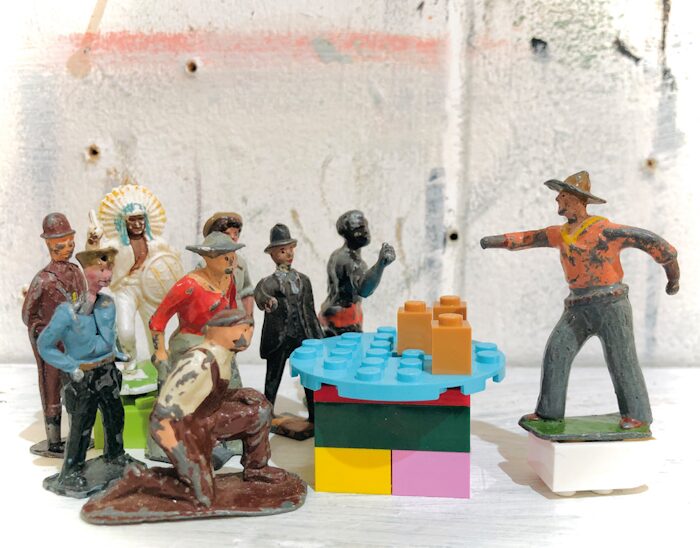
There are also several units and shelves inhabited by scores of small, mostly antique, lead and plastic figures of cowboys, soldiers, workmen, milkmaids and assorted animals. I’m holding up one of these to examine – a cowboy who is missing half an arm – when Alexander returns, carrying our tea and a plate of mini madeleines.
“I can imagine them all coming to life and having a party when you pack up for the night,” I say.
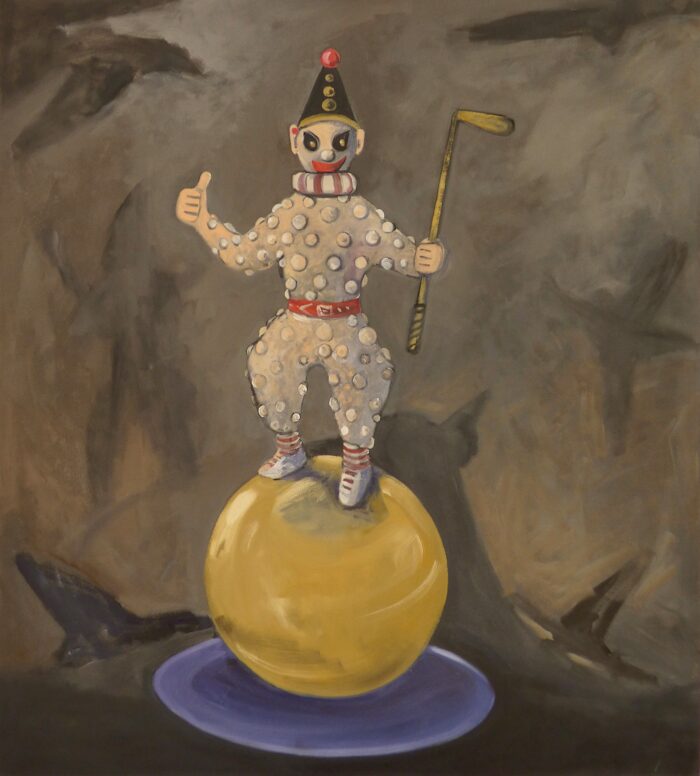
“Like Toy Story.” “Just like Toy Story. But even more retro.” Alexander spends a lot of time, he tells me, in junk shops. It was in one of these, last year (a particular favourite, in Bexhill) that he fell in love with the first figure of his collection, which he singles out from a shelf and brings to me for inspection. It’s an inch-high lead monkey, mottled with faded green and white paint, walking on all fours, with an arched back, and a curling tail. “I think it’s from the thirties. It’s certainly been loved in its time. Much of the paint has come off, which gives its face an ambiguous expression. There’s an intriguing hole in its head, perhaps from the casting. I thought ‘I’ve got to have it, whatever the cost’, which turned out to be £12.” He took it back to the studio, and started sketching it, and soon painting it, “trying to bring out its soul”. He loved the process, and the results.
He started to build up the collection of figures, in junk shops in Bexhill, Brighton, Arundel and Chichester, and from eBay, largely avoiding the all-too-common soldiers, more interested in cowboys and Indians, animals, workmen and female figures (the latter, he found, performing a limited number of jobs, such as milkmaids, nurses, farmers’ wives and fisherwomen). These he used as the starting point for a series of portraits, painting straight onto canvas, letting the process take over, ending up with characters who look distinctly different from their moulded models. Some of them were quick and sketch- like, others worked more carefully, with layer upon layer of rabbitskin glue and oil paint – “the same materials as used by Renaissance painters” – creating depth and substance to his creations. He had brought the toys to life; he had brought out their souls.

Oil on canvas, 35 x 42cm

These portraits are produced between sessions on larger canvases, using the figures as the basis for groups of characters in meticulously composed, you might even say choreographed, scenes. I first saw one of these at the private view of the Newhaven Open Exhibition last summer. It featured a cast of toy-inspired characters, standing round a table: a sailor-hatted figure, a clarinetist, a one-armed cowboy (sound familiar?) and – acting as a focal point – a milkmaid, wearing a flared Dutch bonnet. While markedly different from anything I’d seen by the painter before, I immediately recognised it as an Alexander Johnson; a supercharged Alexander Johnson. Here was a piece with great depth, clearly based, composition- wise, on an Old Master painting, but with an intriguing set of protagonists enticing the viewer to make their own interpretation of what was going on, painted in the artist’s distinctive, rather expressionist style. I stood in front of it for several minutes, and returned to it several times, the last accompanied by Alexander himself (an artist is never far from their work at a group-show private view) who explained the inspiration behind it. This was the first I heard of the toy models; the work, he revealed, titled Slim Pickings, was based on Caravaggio’s Supper at Emmaus. “He’s made a leap,” I thought. And… “I wish I could afford this painting.”
In the autumn, ROSA was asked by the organisers of The Sussex Contemporary open exhibition – held in the same space in Newhaven – to pick out one of the show’s many artists as the winner of the inaugural ROSA Prize, with the idea of featuring their work on the cover of a future issue. It was a difficult choice, with a high-quality shortlist of contenders emerging. But in the end, it was Alexander’s entry that won the day, a large (130 x 230cm) diptych titled Peace Conference, after Leonardo’s Last Supper, with the enigmatic Dutch milkmaid figure again the focal point, this time smoking a joint, surrounded by a group of roguish characters, several bearing arms, and one – intriguingly – carrying an owl. We felt it to be an important work, making a political point without any hint of virtue signalling, full of interesting, mysterious, ambiguous detail, stylishly composed and painted. Peter Doig meets Leonardo da Vinci in a toy-town saloon.
Alexander goes off and makes another cup of tea, giving me time to take another nose around the studio, jotting notes and noticing new detail: I am particularly drawn to a cabinet of miniature curiosities, evoking a spectrum of emotional responses: a photo of the artist as a young man; a pack of Jean-Michel Basquiat playing cards; a tube of ‘Squish & Glow’ neon UV paint; a packet of Woodbine cigarettes. He’s told me his life story before: his father’s lifelong insomnia after visiting the liberated Belsen camp in 1945, his own depression and periods of self-doubt, leading to a stuttering, stop-start art career only now coming to full fruition. The cabinet, I realise, is a revealing self-portrait.
When Alexander comes back, we talk about being 60, laughing at the predicament we’re in, the revealing groan on getting out of a chair. We find another thing we have in common – we both have mothers who have reached their nineties. Alexander’s mum is in a home now, he tells me, suffering from dementia, though ‘suffering’ might be the wrong word. “She is convinced that she is living with all the people she has ever loved, with whom she shares the day, from breakfast time onward,” he says. “Sounds a bit like one of your paintings,” I say, and you can see the thought sink home.
“You know, turning 60 wasn’t a traumatic event in my life or anything,” he says, “but it certainly changed the way I thought about my art. That’s why I spend so much time on the bigger paintings, which are much more difficult to sell. Those are the ones that get me fully absorbed, so I don’t know what time of Left Alexander Johnson with Here at the Western World Photo by Rowena Easton Below A maquette for Here at the Western World day it is. You see I’ve realised that I’m in the last third of my life now – if I’m lucky – and I’ve started thinking about what I’m going to leave behind. My legacy. You don’t get to know if you are a good painter when you’re alive: history decides that, 20 years after you’re dead. It’s about how your paintings live on in the world without you. And I want to leave behind a body of work that’s big enough, and powerful enough, and meaningful enough, to grace the walls of a big gallery, like the Towner, or Pallant House, in a major exhibition.” Or Tate Modern, or the Courtauld, or the RA, I think, but don’t say (though I’m saying it now). I really think that Alexander Johnson’s latest series – let’s call it his Toy Story phase – is of the calibre that, if he gets the right breaks, could just launch his career into a different realm… that could just ensure that people are still talking about him in 50 years’ time, and beyond. And I certainly hope that all the thousands of hours of work in his studio, and all the missed meals – ARE YOU EATING TONIGHT? – will pay off for him, and that this marvellous, magical, meaningful series of work will be followed by another just as resonating, and another after that, and another after that.
Words by Alex Leith
A solo exhibition of new paintings by Alexander Johnson, Where Are We Now?, shows at the Rogue Gallery, St Leonards on Sea, from Saturday 22 March until the end of April.