
Alex Leith catches up with the Hastings-based painter, filmmaker and Krautrocker.

I meet Geraldine Swayne one early July morning at the doorway to her studio, at the top of a flight of wooden steps. Hers is one of fifty units in The Yard, on Waterworks Lane, a collection of Victorian red brick buildings, outsized beach huts and old stables which is home to an oddball collection of artists, artisans and craftspeople, from cake-makers to dog groomers. It’s very Hastings. She’s wearing a black boiler suit, grey tortoiseshell reading glasses and a welcoming smile.
You might have heard of her. This is a painter about whom Artlyst mused, in 2017, ‘Is Geraldine Swayne the best portrait painter in Britain today?’ A musician who spent over a decade touring with the legendary Krautrock band, FaUSt. An experimental filmmaker whose work – with scores performed by Nick Cave – has been shown at the London Film Festival, and way beyond. A multifaceted artist, then, successful on three very distinct fronts.
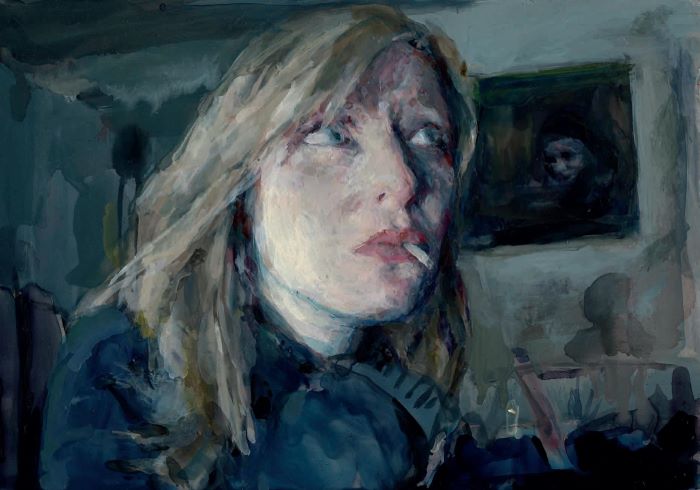
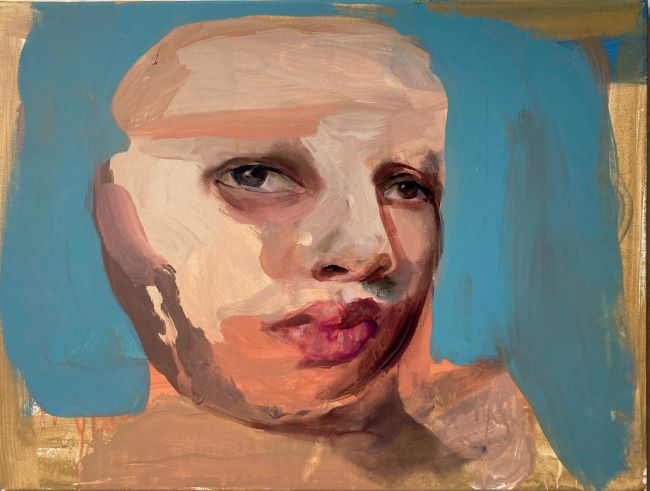
Geraldine leads me into her workspace: paintings and paint everywhere, messy and tidy at the same time, one chair for me, one for her, and a cup of tea in an interestingly shaped vessel. The paintings are all figurative, and they all feature people. Some, on small sheets of glass, are half-way completed, others, on large canvases, look decades old. There’s an Alice Neeliness about the work, an expressionism about the figuration: slightly distorted slices of narrative, bright of colour, dark of tone. Dreamlike.
“There’s often something going on offscreen, as it were,” she says. “If a film director wants to show something cataclysmic, they can either show the cataclysm, or the actor’s face. I prefer to show the actor’s face.”
I ask her to describe her life story to me, so I can try and work out how she got – artistically speaking – to where she is today. Usually, when I go through this process with interviewees, a discernible narrative arc appears: struggle; wrong turning; epiphany; resolution; fulfilment. Like, I guess, the five-act plot of so many traditional movies. Geraldine’s story, though, is much more complicated, and episodic. There are multiple struggles, multiple wrong turns, multiple epiphanies, multiple resolutions, multiple fulfilments. Every episode a movie in itself.
She was born in 1965, and had what she describes as a happy childhood as a ‘totally suburban kid’ in the Surrey hills (and at school in West Sussex) culturally nurtured by her older brother who introduced her to “William Blake, Vivian Stanshall, Ian Dury and the Blockheads… all the cool stuff. By the age of 13 I’d read Bury My Heart at Wounded Knee.” Her vocation as an artist was never questioned by her Irish mother: she did a foundation course at Reigate, which she loved, and a Fine Art degree at Newcastle University, which she quite often didn’t. “I wanted to get as far away from Thatcher’s South as I could,” she explains. But in doing so, she alienated herself from the London scene where “you could feel a head of steam emerging, in the music and in the art. The first glimpses of warehouse parties and acid house. And there I was in Gormenghast, stuck in the life room.” It wasn’t until her last year, when she abandoned experiments in conceptualism to concentrate on her figurative painting, that she found her artistic feet. “I just wanted to get though my degree. I painted and painted and painted.”
She also developed an obsession with the films of Derek Jarman, and bought herself a Braun Nizo camera, like the one he used (she still has it: she stands up and pulls it off the Acrylic shelf, to show me. It’s a sleek, silver, hand-held affair). Once she had graduated, in 1989, she decided her next step should be to go to New Orleans, and make a film about voodoo. As you do. She applied for a grant from the Northern Arts Travel Award. “I later met the woman who assessed me, and she said it was the worst-presented application she’d ever seen, full of Tippex and drawn-on arrows and stuff… but she must have seen something in it, because she gave me the money.”
“It was a real visceral feeling that I belonged there,” she says. “I thought: ‘I’m going to go to New Orleans, I’m going to meet some Cajuns’. And I did: I conjured it. It was a real keystone in my life. New Orleans had the reputation as being the most dangerous city in the States, but nothing bad ever happened to me. I’d wake up wherever I’d kipped and roll up my blanket and find some adventure to go on. I got lent a whole apartment for Mardi Gras; I met the ‘Mayor’ of Dumaine Street, and learnt about the free people of color; I took a trip to Dallas, and filmed the early adopters of hip-hop dancing.” Most importantly, perhaps, she befriended the painter Jonathan Blum. “Talking to him, I learnt the American way of doing things against the English way. In England you are worthy and diligent, and wait to be noticed. In the States you think ‘I want this. Let’s do it.’”
She moved back to Newcastle, which couldn’t hold her for long. “A friend of mine got pregnant, and decided to do a runner. I said I’d go with her. We ended up in Languedoc, in southern France, in an old Roman village near Saint-Guilhem-le-Dèsert. We met a friend, Stanislav Demidjuk, who had been involved in the defence team at the Oz trials in the 60s. Used to say things like ‘Yoko Ono, she was a drag, man’, and ‘Richard Branson? I had a punch up with him over a girl’. He organised an exhibition for me, where I painted some huge paintings that were hung from the balconies of the village square. When I arrived at the opening, the local artists shouted: ‘there’s the artist!’ and they carried me on their shoulders around the village. I love the way the French do art.”
“Soon after that I went to Ireland, to deliver a dog, and I met a fantastic relative, who advised me, if I wanted to get on, I should get on the phone, call everyone I could think of. I went back to London, and did just that. I got an interview at the Computer Film Company, which made special effects for films, for a role as a computer programmer. I’d hardly touched a computer before, but I got the job, and after a twenty-minute tutorial in code, began my new career.” The company made special effects for Hollywood movies, from “a dingy basement in Soho”. “It felt more like an art studio, though, there were so many artists involved. A lot of Oscars were won. It was an exciting period, and I was there for twelve years. Which was too long, to be honest. Essentially, I had stopped painting.”
She was, however, making experimental films, on the side, using the left-over frames from work shoots, a complicated (and illicit) process that involved enlisting the complicit support of a friendly lab technician in Paris. “I eventually assembled a negative of my neighbours doing the Hokey Cokey in the East End. Miriam Margolyes did the narrative, and Nick Cave kindly wrote the music for it. My ex was a Bad Seed, so I was hanging round with that lot at the time.” It was the first film ever to be converted from Super-8 to Imax, a historical steppingstone, and there were plenty more to come. “I made a bunch of weird films recruiting friends to play Jack the Ripper victims, stuff like that.” She learnt beekeeping and made films where she made her actors appear like bees, by stripping out all the dialogue, and leaving in-between facial gestures.
The aforementioned ‘ex’, was her then-husband James Johnston, who Geraldine was living with, in an old school assembly room in Hackney: “a beautiful place, a bit like a commune, with tortoises running free in the garden.” While she was there, two things happened in quick succession. “I was made redundant, and we formed a band, Dot Dot Dot Bender, with this photographer, Steve Gullick. We made two albums and played lots of gigs and somebody must have seen us, because we were invited to play at a festival in Germany on FaUSt’s farm (which Julian Cope described as ‘3 days of Utopia’). We were then asked to join them on a leg of their tour, in Paris, but sadly by the time Paris came about, Dot Dot Dot Bender were no more. I went along anyway, and did an improvised song on stage with the band. I was invited to join.” She played and recorded with FaUSt, off and on, for the next 12 years: singing, playing a variety of instruments, and painting live on stage. Her films were often used as the backdrop. Live painting, music, film: Geraldine Swayne’s three art forms had merged.
2010 was a bad year for Geraldine, and then a good year. “There was a lot of bereavement, a lot of sadness. Then, literally overnight, I started painting miniatures. Within two weeks, I got a gallery to represent me, which is unheard of.” The gallery in question was run by Fred Mann; Geraldine was creating postcardsized paintings, using enamel paint on metal, of friends and artand-music-world colleagues, as well as found images from porn magazines. Intimate, edgy portraits, displaying her talent for condensing detail with fluid brushstrokes. “The miniatures came out of nowhere. Moving from oil to enamel was like the light going on. They bore me along, and they got me out of Dodge.”
The FaUSt experience, moreover, had taught her transferable skills. “Why it worked with FaUSt for so long was that you couldn’t have an ego. It would have just tripped you up. You had to be wide open. Not scared of looking foolish, and getting things wrong. And I’ve been trying to bring that to the painting, to a degree… when it’s going well I can lose myself in it, and if I can’t do that, I’m all at sea. It’s so great when you’re on a roll because you know who you are, and you know what the universe is, and you’re just an instrument in it, and it’s just paradise. Paradise.
But then… clunk. Unfortunately, you have to pop your head out sometimes and deal with something like a leaky roof. Which is what I’m doing at the moment, and it’s fucking killing me.”
She brings up Francis Bacon: “the things he said about being a transmitter, and reaching out to the nervous system, rather than to the brain. I’m 100% behind that.” I ask her about other artist influences, and she says “ooh, I haven’t been asked that for so long.” Then they trip off the tongue: “I used to stare at Degas for hours and hours, those slightly unfinished portraits he did from dodgy snapshots… and then Marlene Dumas, and Chantal Joffe and Jarman, obviously. Now it’s all about Rembrandt. People who try to penetrate the veil, try to get the ego out the way, so you can be true to yourself.”
She’s had good luck, and bad luck with galleries representing her, since she resumed her painting career. Her favourite, I sense, was the Fine Art Society, that august institution which until 2017 had its historic headquarters on New Bond Street, before it was bought out, and moved to Carnaby Street. At that point she left, after a productive three-year spell which involved two solo shows. There were other positive experiences: from 2014, she enjoyed a five-year residency at the ACME Housing Fire Station in the East End. In 2016, she joined Turps Banana, the peer-led independent art school in London, where she remains a visiting lecturer. “It gives you momentum to know that other people are doing the same thing around you with seriousness, with ambition, and with regard.” She moved to Hastings/St Leonards in 2016, and she loves it. “I knew it from my foundation course, when I came to draw the huts,” she tells me. “And my first dealer lived here. The artistic community here is just crazy good, especially round me in The Yard… And did you know we’re nearer to France than to London? I love that.”
It’s been tough going recently. “Lockdown fried me,” she says. “I was asking rather too profound questions. Now when I read about Pepys’ experience of the Plague, I know what he means. It was very frightening at the beginning. I started to examine things like ‘why am I here?’, ‘what am I up to?’, and ‘what do I want to leave behind?’ On top of all that, you’ve got to make a damned living. I’ve got to pay for this studio. It’s tricky. I’ve got giant paintings of depressed babies at home. I’m not going to shift them. I’ve made hundreds of paintings over the last few years. I’ve worked so hard. It’s survival.”
2023 is looking good, though. She has recently started painting her ‘miniatures’ on glass, instead of metal. “I am very interested in surface,” she says. “I am chasing light, chasing translucence: if you look at it one way you can see it, if you look at it another way, you can’t. It’s the idea of the lux continua, the light coming through.” She’s looking forward to some exciting upcoming projects: “working with Jeremy Deller et al in curator Harry Pye’s show Always on My Mind at Fitzrovia Gallery in
London; a show of ephemera at Project 78 in St Leonards in September; a show in Exeter; working with an art consultant in Paris; work at Magazine3 in Stockholm…” She’s also working on a new series of horror films, starring her neighbours in The Yard: “you’ve got to have a bit of fun.” And, as ever moving with the technological times, she’s producing a body of NFTs.
Before I take my leave, I look at her works in progress, in enamel, on glass. There’s a half-Geraldine, half-owl self-portrait; what appears to be a deathbed scene; a couple lovingly holding the headless torso of a baby; several day-trippers examining a concrete pyramid. They are very dark, very interesting pieces. “They’re haunting”, I say. She nods. “People say they might glance at them, and move on, but that they stick around in their heads. Like a funny dream where nothing much happens, but which carries a lot of import. I love it when they say that. They can unlock emotions, too: people have come out and told me terrible traumas over a painting they’ve seen in a show.”
We part, as we’ve met, at the top of the wooden steps, my head full of Geraldine’s crazy stop-start life. And I haven’t even mentioned some other stuff she told me about: the rather traumatic spell at the Wooster Group in New York, the videos she made for MTV, her work with the Chapman Brothers… “ That process felt… odd”, she says, about our interview. “I mean… who was that we were talking about?”
I’m already looking forward to the next act.