

Tom Hasson on Sussex’s hidden treasures: George Graham
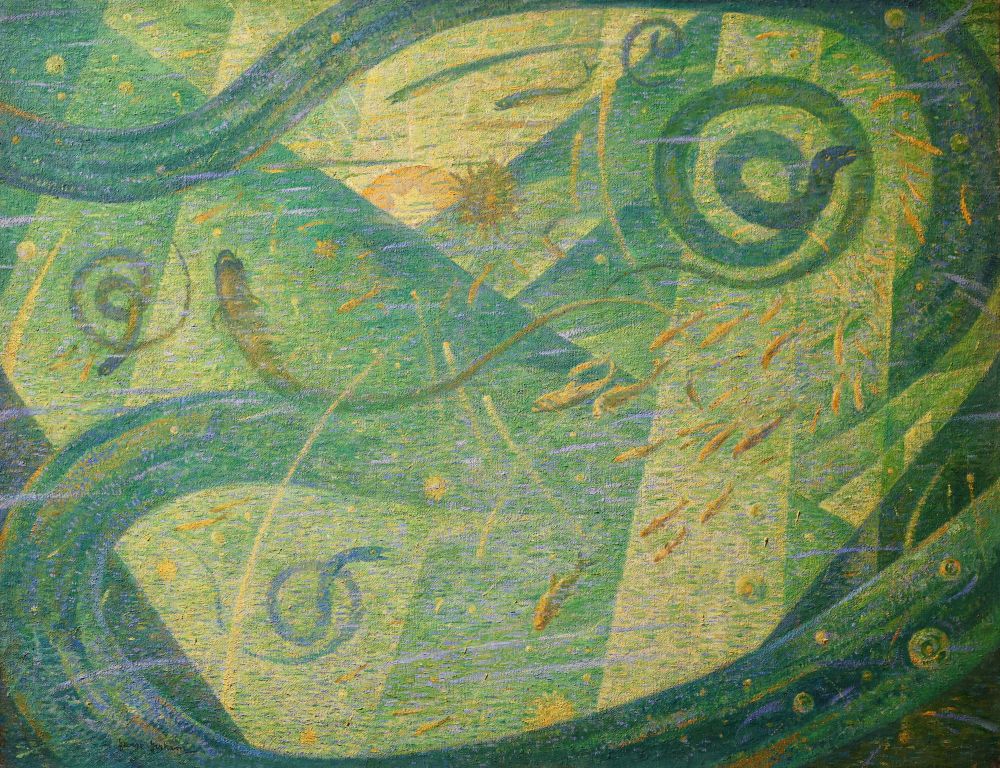
The Creation of Fishes, 1937
Oil on canvas, 71 x 92cm
Six paintings on the walls of Hastings Museum & Art Gallery open the borough-run institution onto something vast and elemental: swirling heavens, radiant suns, emerging worlds. These works reveal a Romantic imagination operating at full voltage. Nonetheless, their author, George Graham (1881-1949), has almost been forgotten.
Graham’s art is driven less by description than by intensity. Like earlier Romantics, he turned from the measurable world toward nature, myth, and the cosmos as sites of overwhelming experience – places where scale and mystery exceed rational understanding. His paintings do not explain these forces; they give them form, translating inner sensation into colour, rhythm, and movement. That this body of work sits outside the usual canon of British Romanticism only sharpens its intrigue.
Born in Leeds in 1881, Graham trained first as an architect before studying painting in London under Sir Frank Brangwyn and Sir William Nicholson. He began as a landscape painter, exhibiting at the Royal Academy from 1908 and producing attentive views of Yorkshire and East Sussex. Yet as his life progressed, his work shifted dramatically.
At eight, Graham lost most of his hearing after being struck by an object thrown by another child. By later life he was almost completely deaf. This shaped not only his social world but his artistic one. As his hearing deteriorated, his paintings became increasingly cosmic and visionary, expressing what he sensed internally rather than what he could observe externally. Silence, for Graham, became a space of imagination rather than absence.
This transformation is vividly present in The Creation of Fishes, perhaps the most compelling of the works on display. Rather than illustrating a biblical moment literally, the painting evokes creation as a restless, surging process. Forms ripple and cluster across the surface, suggesting life not as a fixed state but as something continually coming into being. There is no horizon, no stable point of reference; the viewer is drawn into a field where energy precedes form.
Colour and shape operate emotionally rather than descriptively. The painting resists anatomical clarity, favouring rhythm and sensation over recognisable imagery. Life seems to emerge from turbulence, from a churning visual environment that feels both generative and unstable. In this way, Graham aligns with the Romantic sublime – not as grandeur alone, but as an encounter with forces that exceed human control.
Like the storms of Turner or the elemental landscapes of Friedrich, The Creation of Fishes offers no reassurance. It provides no sense of mastery over nature, no clear separation between observer and event. Instead, it places the viewer inside the act of creation itself, asking us to experience rather than analyse. Creation here is visceral, rhythmic, and charged with motion.
The surrounding works echo this vision. Earth, Sun, Moon and Star reduces the cosmos to elemental relationships, held in balance through colour and structure rather than scientific logic. The Morning of Creation and The Creation of Day and Night approach beginnings as moments of tension and transformation, where light and matter struggle into definition. Veni Sacre Spiritus gestures toward spiritual invocation, yet Graham’s faith is expressed through sensation and movement rather than doctrine.
What binds these works is Graham’s sensitivity to rhythm, shaped by his relationship to sound and silence. Music remained central to his inner life even as his hearing faded. Rather than abandoning it, he translated musical structure into visual form. He would begin a painting with a few shapes and build outward through contrasts of ‘quick active rhythm and slow stillness.’ In The Creation of Fishes, this musical logic is unmistakable: the eye moves across the canvas as if following a score, guided by tempo and variation.
This synaesthetic approach reflects a Romantic belief in intuition and inner perception as valid forms of knowledge. Graham’s paintings do not attempt to represent what he could no longer hear; they give form to what he continued to feel. That these works now reside quietly within a regional museum feels fitting. Despite decades of exhibiting at the Royal Academy, Graham remains marginal to dominant art historical narratives. His paintings endure not as monuments, but as secrets – traces of a vast inner world shaped in relative isolation.
Seen today, these six works remind us that Romanticism is not a closed chapter but a recurring impulse. In The Creation of Fishes, Romanticism speaks through movement rather than declaration. To stand before it is to be reminded that art can still function as encounter rather than explanation – and that some of the most resonant Romantic works are those still quietly waiting to be seen.