
Tom Hasson on Sussex’s hidden treasures #2
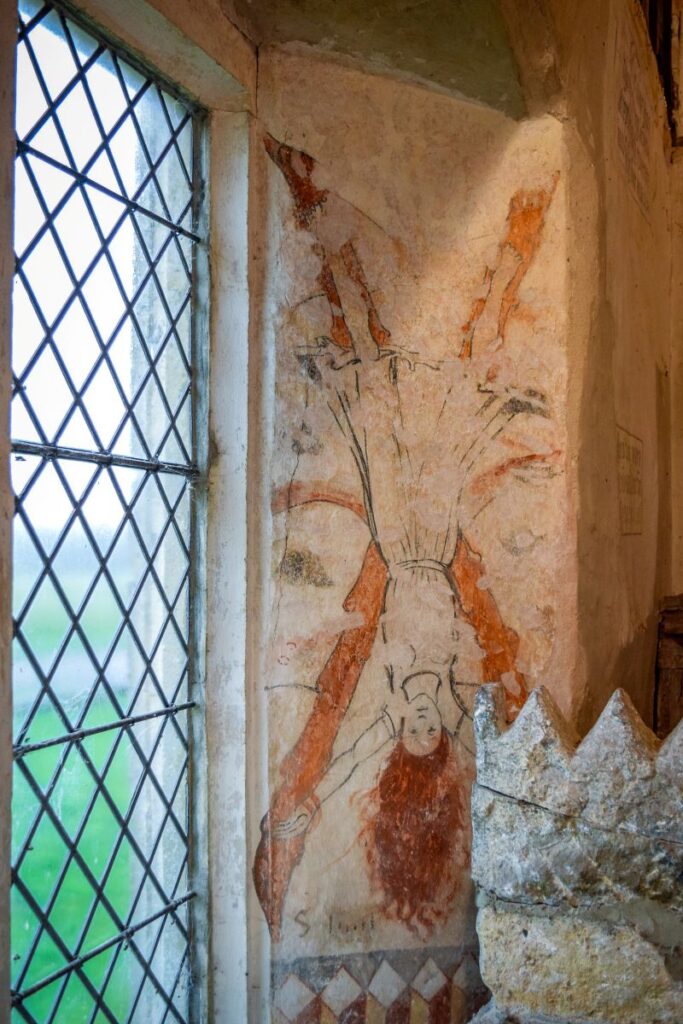
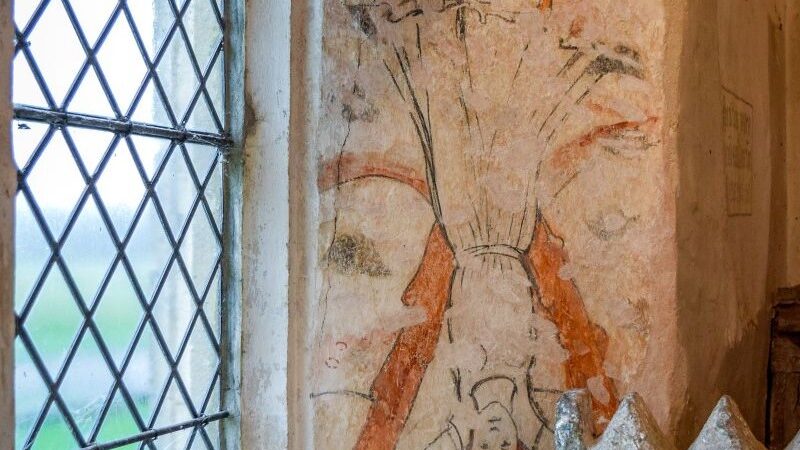
Amid the quiet beauty of the 11th-century St Richard’s Church in Burton there’s a disturbing wall painting that continues to perplex and fascinate art historians and visitors alike. Hidden high on a semi-obscured wall, it depicts a young woman bound upside-down to a cross, her vibrant red hair cascading toward the floor. Faint with age, this early 16th-century artwork is believed by many to portray St Wilgeforte, an extraordinary and largely forgotten figure from medieval Christian folklore. Wilgeforte’s story, one of defiance, faith and tragedy, transforms this tiny church in West Sussex into an unexpected gateway to the rich tapestry of European religious history.
St Wilgeforte, or Wilgefortis, occupies a curious niche in Catholic legend. Said to have been one of the nine daughters of a pagan Portuguese king, Wilgeforte vowed to devote her life to God and remain chaste. Her father, however, had different plans, arranging her marriage to a powerful suitor. Desperate to escape, Wilgeforte prayed for divine intervention to save her from the unwanted nuptials. Her wish was granted: she miraculously grew a beard, repelling her would-be husband and scandalising her father. Furious, the king had her crucified upside down, and she became a martyr, celebrated in parts of Europe as a patron saint of oppressed women and those seeking liberation from unwanted unions.
The Burton wall painting offers a rare visual interpretation of Wilgeforte’s legend. The work has been dated to the early 1500s, placing it at a time when such devotional imagery would have been vital in illiterate rural communities as both a spiritual and educational tool. The painting sees Wilgeforte crucified upside down on a diagonal cross, her striking red 82 ROSA issue 13 FIN.indd 82 hair dominating the composition. This may carry symbolic weight, linking Wilgeforte’s martyrdom to the fiery passion of her faith. Although her beard is absent – possibly due to the artist’s decision or deterioration over the last half century – the painting’s overall narrative aligns with her story.
The presence of such a figure in a Sussex church hints at broader cultural exchanges between England and mainland Europe during the late medieval period. Wilgeforte’s cult, though popular in parts of Germany, Spain and Italy, was far less well-known in Britain, making her depiction here a fascinating anomaly.
St Richard’s Church itself provides the perfect setting for this enigmatic artwork. The church has long been associated with the Goring family, influential landowners who resided at nearby Burton House for centuries. The family’s wealth and connections likely influenced the church’s artistic patronage, making it a repository of unique and rare treasures. The chancel is built using original Petworth marble and the nave is adorned with memorials to the Gorings. A variety of Biblical texts, including the Ten Commandments, are written in beautiful black lettering dated to the 17th century, all visible above the 15th-century crenellated screen.
Throughout the 16th and 17th centuries, due to the iconoclasm of the Reformation, many religious artworks in England were destroyed. That this painting survived suggests it may have been deliberately concealed, or deemed unthreatening to Protestant sensibilities. Its continued existence offers a wonderful glimpse into pre Reformation spirituality in Sussex.
What makes St Wilgeforte so compelling today is her enduring relevance to conversations about gender, autonomy and resistance to societal norms. Her miraculous transformation – growing a beard to escape a forced marriage – directly challenges patriarchal definitions of femininity and beauty. By subverting these expectations, she claimed her independence.
St Wilgeforte’s story also speaks to the power of defiance in oppressive circumstances, transforming her from a subject of patriarchal control into a symbol of courage and agency. Her story forces us to question conventional narratives, offering an image of female resistance that feels surprisingly progressive for its time.
For contemporary audiences, her legend intersects with broader issues of self-determination, gender fluidity and identity, demonstrating the timeless nature of stories that challenge societal boundaries. This is reflected in how Wilgeforte is known in other languages outside of English. It is thought that the name originates from the Latin ‘virgo fortis’, which can be translated to ‘courageous virgin’. However in English she is also called Uncumber, and Ontkommer in Dutch, meaning ‘one who helps others avoid suffering.’ In German, she is known as Kümmernis (‘grief’ or ‘anxiety’), and in Poland, as Frasobliwa (‘sorrowful’). In France, she is Débarras (‘riddance’). Whether seen as a protector, a source of comfort, or a symbol of personal agency, she transcends linguistic and cultural boundaries. This adaptability underscores her relevance today as an enduring f igure of resistance, offering inspiration to those seeking to rewrite their narratives and challenge societal expectations.
Centuries of environmental exposure has left the painting fragile, making Sussex’s St Wilgeforte all the more special. For those inspired to see this extraordinary work, St Richard’s Church offers a serene retreat in the heart of West Sussex, and is open to visitors for 365 days of the year. What’s more, you’re only a ten-minute drive from Petworth, home to Newlands House Gallery, Ottocento and Kevis House Gallery, among others. And of course, the National Trust’s Petworth House & Park.
While the painting of St Wilgeforte may not be as prominent as other Sussex landmarks (it’s obscured even within the church itself, half-hidden behind a large stone memorial), it rewards those who seek it out. In its quiet, weathered beauty, it speaks to the enduring power of stories – stories of faith, defiance and the human spirit. In a world where so much of history’s nuance is lost to time, this wall painting stands as a testament to resilience. It invites us to look beyond the grand narratives and into the hidden corners where forgotten stories can still inspire.