
I do love a brush. Always have. My earliest brush with bristles sticks in my kinaesthetic memory bank – the feel of the softest of soft bristles of a baby’s hairbrush bestowed on the occasion of my birth. It had an heirloom feel, and was probably made of natural fibres (hair from a pony mane?) attached to some form of heavy plastic. Fairly quickly my head mop overpowered that of the pony’s, and the brush was relegated to a sensory toy, a tool to stroke my palms in moments of angst.
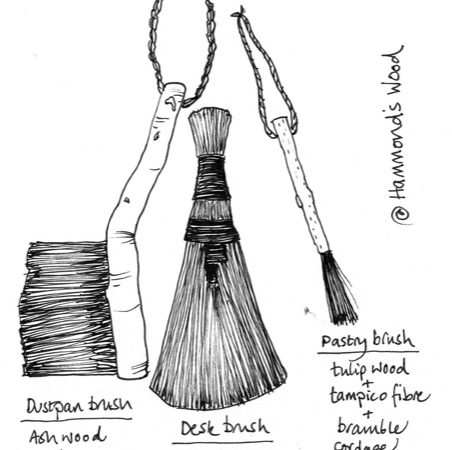
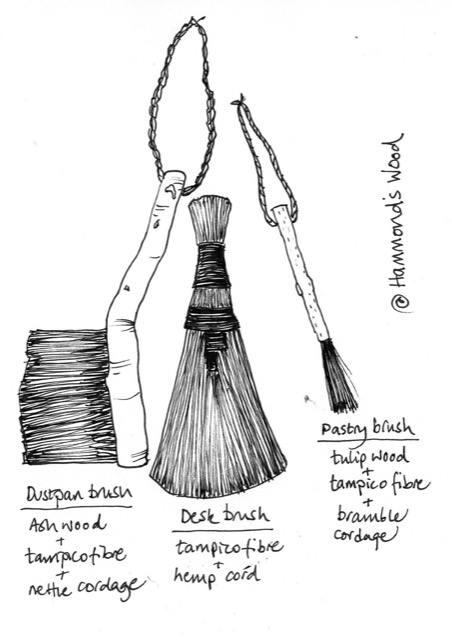
Last year, at the inaugural Hastings Craft Weekend, I’d been magnetised to a stall selling a range of forest-hewn brushes. The owner, a seasoned green woodworker who crafts as the ‘Woodmungler’, invited me to spend a day with her in Hammond’s Wood, sourcing materials and constructing my own mini-range of sweepers. We chain-drank tea made on a tinny log burner and grappled with creaky hand drills. Time flew as we bored beautifully regimented holes down angular beech sticks, and twisted cordage hangers. The resulting tools seemed to fit my grip so comfortably they felt like an extension of my arm, like some sort of natural prosthetic.
Brushes are the unsung heroes of the universe, the safety-net stopping humanity becoming generally unkempt and grubby. Think how many brushes you own. I’ve already clocked at least seven I’ve used before writing this at 11.03 on a Thursday morning – hair, tooth, broom, dog, washing-up, clothes and desk brush (one of my faves, especially as breakfast involved toast-on-the-type). Even in this age of automation, brushing remains one of the most effective ways to clean, groom or apply. The brush is probably one of humanity’s oldest tools, enduring tens of thousands of years of the same principle – fibres bound to a handle. Not successfully replaced yet (IMO) by machines, despite the best efforts of Dyson and his many hydra-ed vacuum cleaners.
Brushes have infiltrated my psyche to such a degree that I’m hereby decreeing 2026 ‘The Year of the Brush’. Brushes will take centre stage in my studio practice, teaching and research. I’ve spent some happy hours studying the delicious Victorian hardware catalogues of FJ&Co who offered a tremendous range of bristles for every eventuality: from their J819 specialist gas stove product (the ‘Nosey Parker’), to J2899, their mysteriously dual-use ‘Dental plate or Manicure brush’. I’ve even joined the niche ‘Society of Brushmaker’s Descendants’, I’m that obsessed.
I’m brewing the idea that brushes have endured through a world of lightning speed change, retaining purpose and relevance. Despite the arrival of the high-tech versions (carbon fibre brushes in electronics, glass fibre lab brushes for precision cleaning, medical micro-brushes in delicate surgeries) many brushes can still be hand-crafted. They are highly effective and beautiful tools, made from the simplest of sustainable ingredients. I can’t think of a more reassuringly real object to make or teach to remind us of our connection to materiality and to using our hands to create things. If any of you were gifted James Fox’s sunshine-yellow book Craftland for Christmas, then you’ll get the sentiment. If you haven’t yet been blessed, then go read, and maybe suggest a chapter on brush-making for the second edition?