
Simon Roberts’ decades-long attempt to define the British landscape
Courtesy of the artist/
Flowers Gallery
In August 1824, John Constable, on a prolonged stay in Brighton for the sake of his wife’s health, made a visit to Devil’s Dyke, and recorded his reaction in a letter to his friend John Fisher. ‘It is’, he wrote, ‘perhaps the most grand & affecting natural landscape in the world – and consequently a scene most unfit for a picture.’ Too beautiful to render faithfully in paint! The artist seems to have only made one quick, unfinished pencil sketch of the scene, later using the other side of the paper for a more detailed drawing of fishing boats on Brighton beach.
“Look, there’s the Constable quote!”, says Simon Roberts, as we drive past a large sign announcing we’ve arrived at the summit of the hill overlooking the glacial valley. Roberts, based down near the seafront in Hove, is one of Britain’s foremost contemporary photographers, and is a frequent visitor to Devil’s Dyke. He is close to completing his latest project, attempting to distil the essence of the site, and the land surrounding it, not in one image, but in myriad, employing many different media in the process. His mission is to capture the uncapturable. Or at least his version of it.
Focusing on one small geographical area is a departure for Roberts, who established his reputation creating sweeping photographic surveys, both abroad (Motherland, Impressions de Normandie) and at home (We English, Pierdom, Merrie Albion). Latterly he has experimented with multi-media approaches, but the methodology for which he is best known is photography examining how people engage with the environment around them, taken on a large-format camera from an elevated viewpoint (often from the roof of his motorhome). He describes this as ‘capturing the midriff of the landscape’.
Before being driven up to Devil’s Dyke, I’ve been chatting to Roberts in his studio in Industrial House, near Hove Station, neatly stacked with photography books, examples of his work, and the paraphernalia of his profession. He makes me a coffee, and tells me about other photographers who have made a habit of clambering atop ladders and cars to achieve a more dynamic view of their subject matter: Bernd and Hilla Becher, Joel Sternfeld and Ansel Adams.
It was Adams’ work which sparked Roberts’ creative epiphany, while on holiday with his parents in Yosemite National Park in the summer of 1988, aged 14. They took him to an exhibition of Adams’ photographs of Yosemite, which ‘blew him away’. “He managed to produce a much more engaging view of the landscape than I’d had myself”, he explains. “After that, I saw the Yosemite landscape in a different light. I saw the world in a different light. As soon as I got home to England, I bought myself a camera. Before that I’d been more interested in riding my BMX than art.”
He wanted to study photography at university, but his parents discouraged this, so he took Human Geography instead, at Sheffield University, graduating in 1997. It served him well… eventually. “It was a good fit for my photography, as in the early 90s there were a lot of cultural geographers starting to write about photography and the visual image as a way of exploring ideas around landscape and the construction of identity, like David Matless and Stephen Daniels,” he says.
Nonetheless, at first, he went down a more conventional photography career route, taking a photojournalism course in Sheffield, “which was basically teaching you to be a news photographer”. He dropped out after six months. “I was travelling around doing things like Yorkshire’s biggest cat and standing outside Sheffield Crown Court, and the worst day was when I had to do a ‘death knock’, where I was sent to try and clear out a house of all the photographs of a child that had died.”
He approached Brendan Ingle, the trainer of Sheffield-based boxer Prince Naseem Hamed, asking if he could get access to the then-world-champion as the subject of a project. “Brendan said: ‘forget Naz. You want to go photograph Daniel?’ He pointed at Daniel Teasdale, who was 13 at the time, and he said, ‘This kid’s going to be bigger than Naz.’ Of course I believed him, and I spent a year photographing Daniel (who also happened to tap-dance), and those pictures won the Ian Parry Award, which was sponsored by the Sunday Times Magazine.”
Courtesy of the artist & The Speaker’s Advisory Committee on Works of Art
Teasdale’s eventual career was relatively low profile, but this was Roberts’ big break. He moved to London and picked up plenty of work from the Sunday Times Magazine and other national publications, “doing things like a clandestine gathering of pyromaniacs in the Nevada desert, and then this leprosy colony in Zimbabwe that had been set up by a Catholic priest, and a group of Franciscan friars from the Bronx who set up a basketball club in East London.”
“I never felt at home in that environment, though, in the sense that I was creating stories that I was fascinated by, but I often found I had no narrative control over the final output,” he says. “I realized that I could achieve that through the medium of the photography book and through exhibiting: in that way I could control the narrative arc and the presentation of the work and create something that would also have some – I hate the word – but some legacy beyond tomorrow’s recycling bin.”
“And so in 2004 I decided to move with my wife to Russia, and we spent the next year travelling across that vast country, from the Far East back to Moscow, taking photographs in over 200 locations.” Largely using a Mamiya medium-format camera, Roberts created an intimate, unclichéd portrait of the Russian people, united by a shared love of their country, “all imbued with this sense of struggle and nostalgia and pain”. The resulting publication, Motherland, published by former Magnum director Chris Boot, was critically acclaimed, shortlisted for the Arles Contemporary Book Award and selected as one of PhotoEspaña’s Best Photography Books.
Roberts and his wife flew back to England on July 7, 2005. “When we landed at Heathrow, we weren’t allowed off the plane for three or four hours. Then the news started filtering through that there’d been a terrorist attack. When we were driving home, there were these signs on the motorway stating ‘London is closed’… For months afterwards there was much soul searching about our national identity and questioning about who was the enemy within. And I thought ‘this is a really important time to begin looking at my own country and what that means, and how people experience it.”
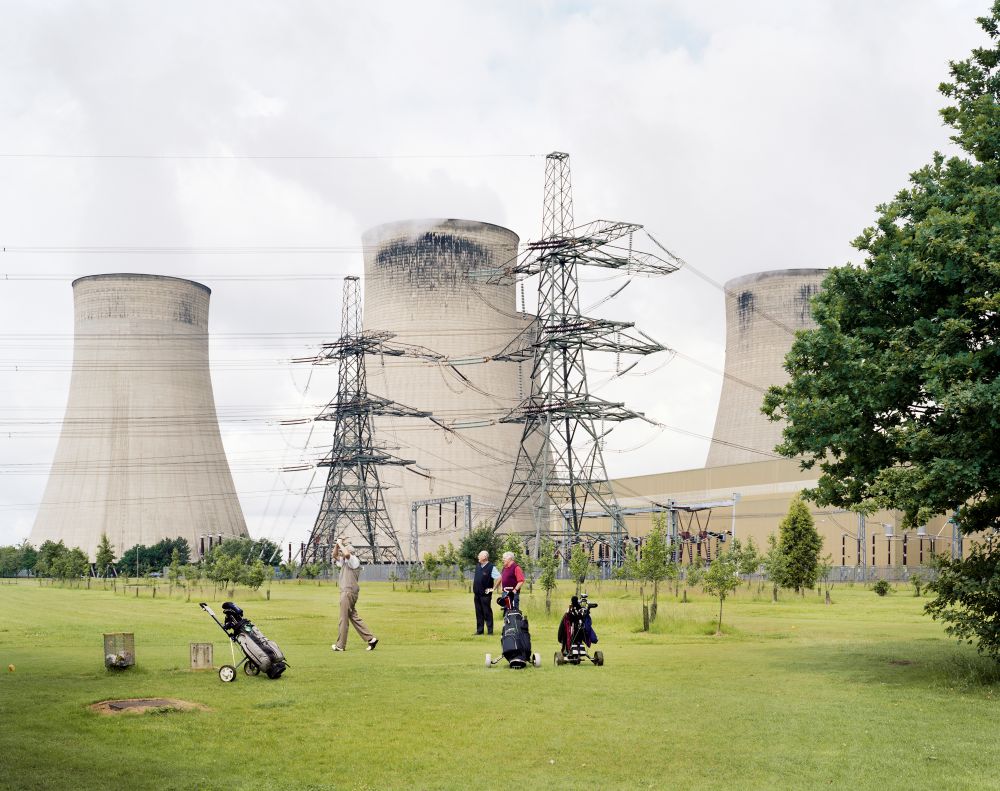
Aware that the Scots and the Welsh had a very acute sense of identity, while the English didn’t, Roberts decided to focus on England. “We got this motorhome and me, my wife and our then-two-year-old spent a year travelling around England photographing the landscape… and in particular how we, the English, use the landscape.” Wanting to engage his audience in the act of representation, he created a website on which he asked the public to invite him to events and places they felt best represented ‘their’ England, from a 50th birthday party on the banks of the River Cam to a game of golf under the cooling towers of the Ratcliffe-on-Soar Power Station.
Courtesy of the artist/Flowers Gallery
His compositions, taken on a 5×4 large-format camera, were influenced by the peopled landscapes of the Flemish Old Masters, historical paintings by William Powell Frith, the photographic tableaux of Jeff Wall and Andreas Gursky and John Hinde’s photos of Butlins from the 1960s. He built a platform atop the motorhome, à la Ansel Adams, to afford him the elevated viewpoint that came to characterise his work. “I wanted to make sure that I wasn’t just re-presenting a Tony Ray Jones or Anna Fox photograph, because there was a very strong tradition of British photographers going out to explore the British psyche. So while I was deliberately positioning myself within a lineage, I was finding my own artistic vision, trying to add a piece to the wider jigsaw puzzle in this historic narrative.”
The project, titled We English, was a resounding success, with the resulting book, again published by Chris Boot, in 2009, selected by Martin Parr as one of the 30 most influential photobooks of the decade. Roberts’ tableaux were displayed at a major exhibition at the UK National Media Museum in 2010, which then went on tour to over 30 galleries across the world, from the Centro Brasileiro Britânico in Sao Paulo to the Australian Centre for Photography. He also began working with Flowers Gallery in London.
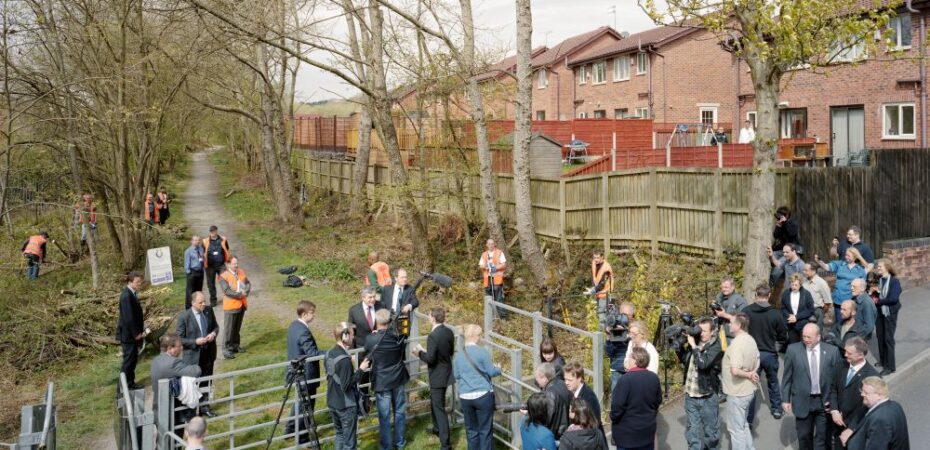
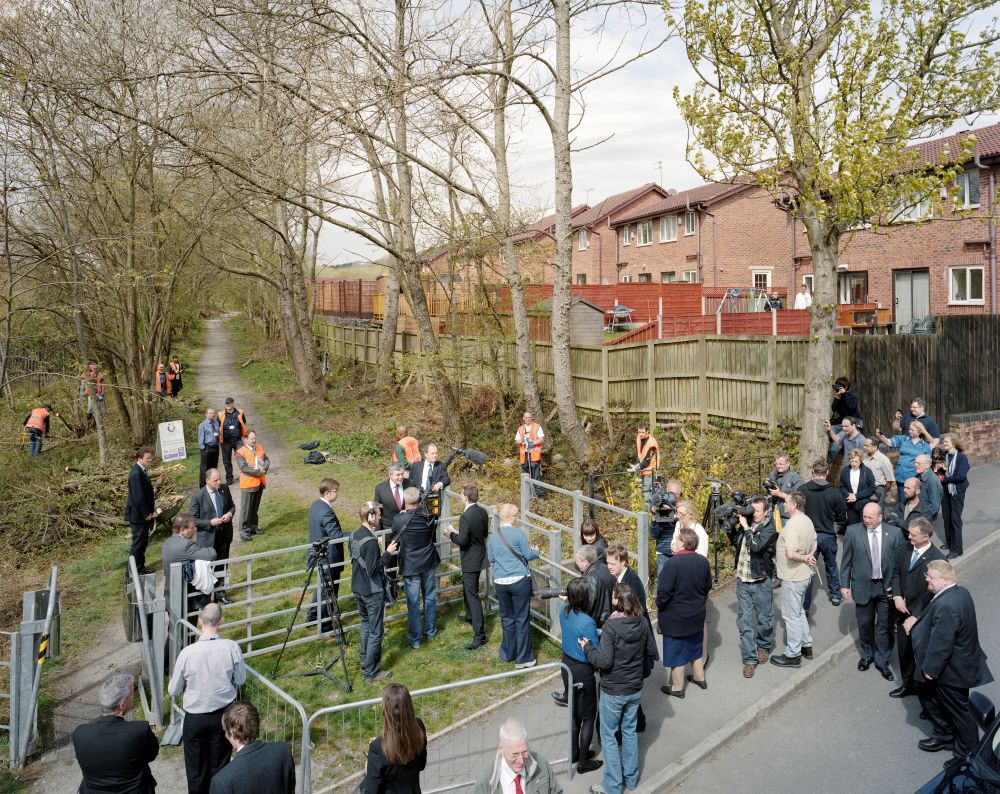
On the back of that triumph, Roberts became the first photographer to be appointed as official British Election Artist, in the build up to the 2010 General Election. He produced 25 large-scale tableaux photographs, each representing a day on the campaign trail, plus one final image of the coalition talks. His images, a far cry from the familiar mass-media close-ups, offered a detached, almost theatrical perspective, focusing on the relationship between politicians, voters, the press and, importantly, the British landscape. One image, taken in Rochdale and capturing a moment seconds before Gordon Brown’s fateful meeting with ‘that bigoted woman’ Gillian Duffy, would, in its own right, be worthy of an article of this size.
Aware of the rise of the ‘citizen journalist’, enabled by the galloping ubiquity of the smartphone, Roberts invited the public to submit their own photographs of the election build-up via a dedicated website, resulting in 1,696 crowd-sourced images that formed a ‘Public Gallery’ to accompany his tableaux. The project was exhibited at Portcullis House in London and added to the UK Parliamentary Art Collection.
Eight of these images are included in Roberts’ photobook Merrie Albion (2017), a decade-long chronicle of Britain’s shifting social and political landscape, which he pulls off the bookshelf, announcing, to my joy and surprise, “you can keep that, if you like.” The book starts and ends at the seaside: the opening photograph depicts a group of elderly bathers dressed in stripey Victorian swimsuits and mob caps, cheerily celebrating the 2007 Broadstairs Dickens Festival, on the Isle of Thanet. The last picture is of Beachy Head, taken on March 24, 2017, in the week Teresa May triggered Article 50, the start of the two-year process taking Britain out of the EU. The white cliffs are clearly chosen to symbolise Britain’s alienation from the rest of the Continent: a rambler stands perilously close to the edge, looking down to the sea.
Flowers Gallery
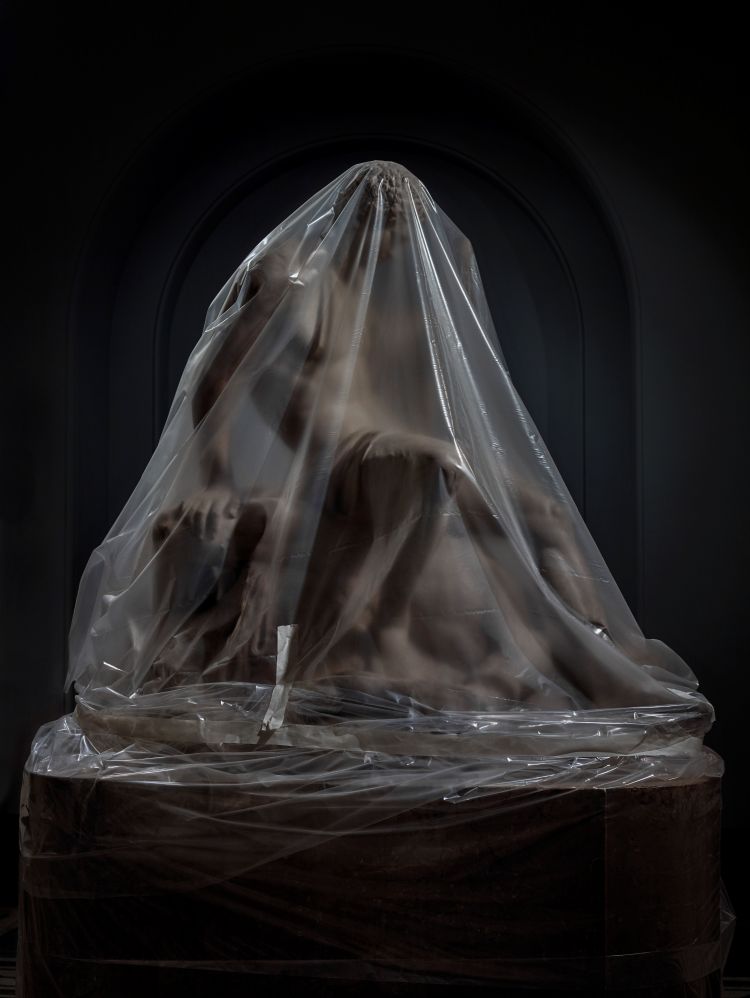
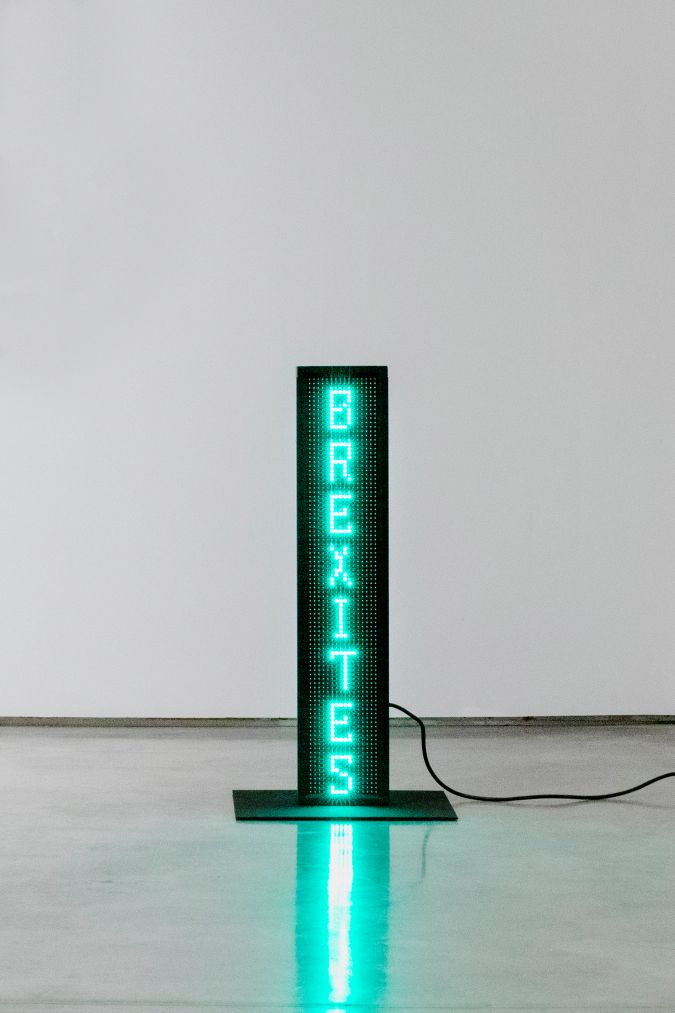
Brexit “angered” Roberts, and his dissatisfaction led him to changing his MO, switching to other mediums, notably a video installation about the subject, “mostly based around text and audio”. Since 2017, a period which, of course, envelops the Covid-19 pandemic, his projects have included The Thames Wunderkammer (2017), a public commission incorporating photographs, historical illustrations and objects found while ‘mudlarking’ in the Thames Estuary, The Weeds and the Wilderness (2017-2020, examining our alienation from the natural world), Brexshit Times (2021, a satirical artist zine marking the end of the Brexit process), Beneath the Pilgrim Moon (2021, featuring photographs of veiled statues inside the Victoria & Albert Museum taken during the second COVID-19 lockdown) and Cathedrals Are Built In The Future (2022, a monograph exploring religious architecture in Cuba).
The Devil’s Dyke project, being a prolonged study about how we interact with our surroundings, seems to be something of a return to type for Roberts, which he tells me more about as we drink a pint on the terrace of the Devil’s Dyke pub, overlooking the glacial valley. He took to walking his dog in the area during the Pandemic, and decided to embark on the project in 2021, after witnessing a telling vignette. “I saw this coachload of tourists pull up in the carpark, and they all piled out, and went to the edge where there’s a stereoscopic telescope. Then they all got out their phones and took some photographs. After about five minutes, they got back on the coach, and off they went. And I was fascinated by the way they were just registering that they’d been to Devil’s Dyke, presumably to share on social media. And actually, what they were looking at was the Weald of Sussex stretching over to the North Downs, not Devil’s Dyke at all, which was behind them, the other side of the pub.” “This got me thinking about the relationship between a place and how we picture it, and how we experience it, and how you can try and bring those two things together. Thinking back to Constable’s quote: is it even possible to truly represent a landscape in a single image? So then I tasked myself with this impossible project, which was to capture Devil’s Dyke. I saw it as an experiment in failure. I’ve basically spent the last few years returning here with all kinds of tools, from 5×4”, stereoscopic and digital cameras, to utilising AI, Google Image Search and video as a way of trying to excavate the landscape. A landscape that is always changing: our experience of it can only be made up of a whole series of fleeting moments that come together to create a sense of a place. You could call it a pilgrimage.”
The first step of that pilgrimage – the first photograph he composed in 2023 to kick-start the project – is the image you can see on the cover of this magazine. It features Roberts standing on the top of the hill, the Weald of Sussex behind him, his head and upper body obscured by a framed print of the photograph he took of the same spot for the We English project, back in 2007. A reminder of his attempt to do what Constable failed to do, and capture Devil’s Dyke in one shot. “I never liked that photo much,” he says, “I thought it a little over-romantic. But Chris Boot persuaded me it was that which made it particularly relevant, putting the other photographs in the project into perspective. Maybe unsurprisingly, it ended up being the most popular image in the book: the limited-edition print sold out very quickly.”
Simon Roberts drives me back down to his studio in Hove, chatting about the myth that gave Devil’s Dyke its name, how the area was the site of a hugely popular Victorian pleasure park, attracting up to 30,000 visitors a day, and – most surprisingly – how he has in recent years started a sideline career as a movie extra, generally playing a conventional photographer. Back in Industrial House, this very unconventional photographer shows me the empty shell of what is soon to become POST, a photography gallery/studio/lab he’s setting up with Nina Emett, director of FotoDocument, which should be up and running by the time you read this article. Before I leave, Merrie Albion clutched under my arm, I realise I haven’t asked him the name of the Devil’s Dyke project. “A Scene Most Unfit for a Picture,” he says, smiling. Of course it is.
Words by Alex Leith
POST is opening in a 3,000 sq/ft industrial unit near Hove train station and will house affordable artist studios, a community B&W darkroom, a photographic studio, an exhibition and events space, a hot-desking zone, and a library. post-creatives.co.uk
To see more of Roberts’ work visit simoncroberts.com