
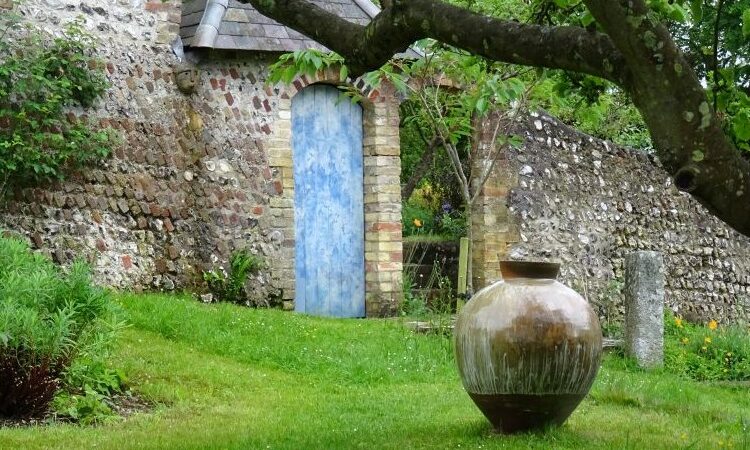
Lulah Ellender visits the South Heighton Pottery garden.
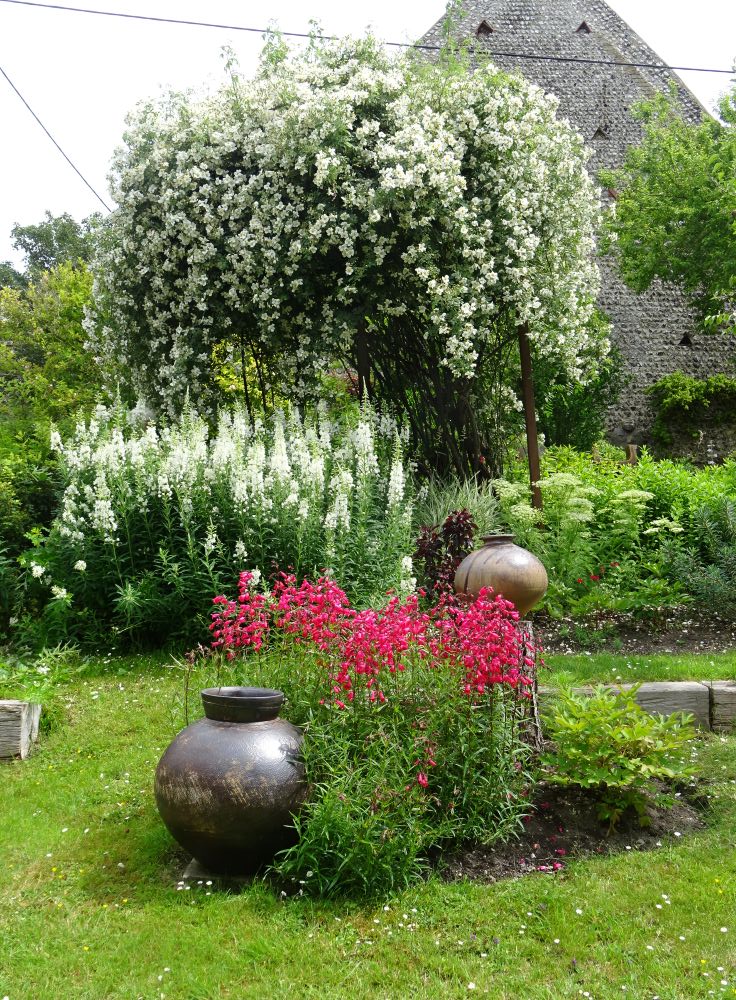
Some gardens take centre stage, while others are designed to be scenic backdrops to some other main show. The garden at South Heighton Pottery, just off the busy Newhaven Road, somehow manages to do both. Home to ceramicist Chris Lewis and his wife Rachael, the garden wraps around a pretty flint house and slopes down towards the barns and studios where Chris works. He first came here in 1976 as an assistant to another potter, Ursula Mommens, who needed help with the more physical work in her later life. Mommens (who was Charles Darwin’s great-granddaughter) moved here in 1951 with her second husband, sculptor Norman Mommens, and continued making work until her late nineties. In her time the garden was wilder, but after her death in 2010 Chris and Rachael cleared, planted and nurtured it into the stunning space it is now. While Mommens’ legacy is visible in the old roses and fruit trees, Rachael has cleverly turned it into an arena for Chris’s pots. For over 70 years this place has been a working pottery and home to skilled craftspeople – a heritage that seems as grounded in the earth here as the gnarly apple trees.
Like Mommens, Chris primarily makes functional pots but uses pattern, glazing and figurative embellishments to create distinctive pieces. He is inspired by his travels to Africa, Asia and America, where he takes an ethnographic approach to learning about how pots are made in other cultures. Every year he and Rachael open their garden and 74 ROSA issue 13 FIN.indd 74 gallery space to the public, showing his work alongside pieces by other artists, sculptors and makers. Preparations for the show start six months in advance, culminating in a five-day firing in the huge wood-fired anagama kiln at the bottom of the garden. Despite it requiring lots of space and vast quantities of wood, Chris likes to use this method because the movement of flames through the kiln creates distinct patterns on every pot and a depth of colour and texture you can’t achieve with electric kilns. He uses the wood ash to make different glazes and mixes clays from Devon and Cornwall to get the perfect recipe.
Although the garden doesn’t directly influence his work, these elemental reactions and forces bring the natural world directly into his process. A glaze made from fig tree ash will have different properties than an oak ash glaze. A pot fired at the front of the kiln will cast shadows across those behind it. Fire, ash, earth, wood – it is an alchemical process as well as artisanal skill.
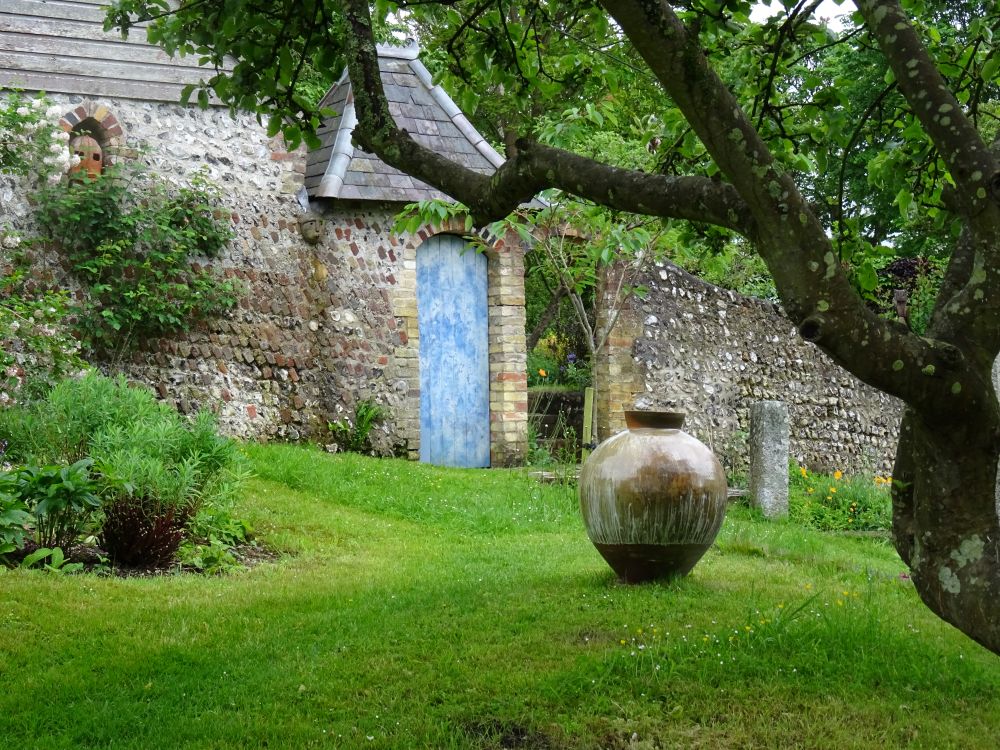
This interplay between elements and art is reflected in the garden display. Large pots sit amongst a carpet of spring f lowers; beautiful curved seats invite lingering; a surprising Polynesian figure and Egyptian sarcophagus punctuate the quintessentially English scenery. These pieces lead the eye in certain directions while merging softly into the landscape. I visit on a crisp, cold spring day. Chris is up a ladder attending to the studio roof. He takes me to meet Rachael and they walk me through the garden. We start at the side of the house where the sun filters through pots of tulips on a terraced patio. To the right is an area that used to be known as ‘The Jungle’ until Chris dug out the brambles. It is separated from the main space by a green and purple beech hedge Chris planted some 30 years ago. He tells me about his obsession with beech – the texture of the bark and the shadows it casts. There are curved beds filled with peonies, sedums, spirea, sweet box, bottlebrush and hibiscus. A bird bath sits on top of a clay land drain, salvaged from the garden’s previous incarnation. Shells strung on fishing line and old groyne-wood sculptures position this garden in its coastal landscape.
Moving back down to the house we pass a sea of hellebores, some of which came from Leonard Woolf’s garden at Monk’s House in nearby Rodmell. Like most gardens, plants arrive from and are shared with others – there is a rose grown from a mother-in-law’s cutting, and another from a cutting Mommens smuggled back from Colombia in her sponge bag. Rachael gives me an envelope of beans collected from last year’s crop so I can bring something of this garden into mine.
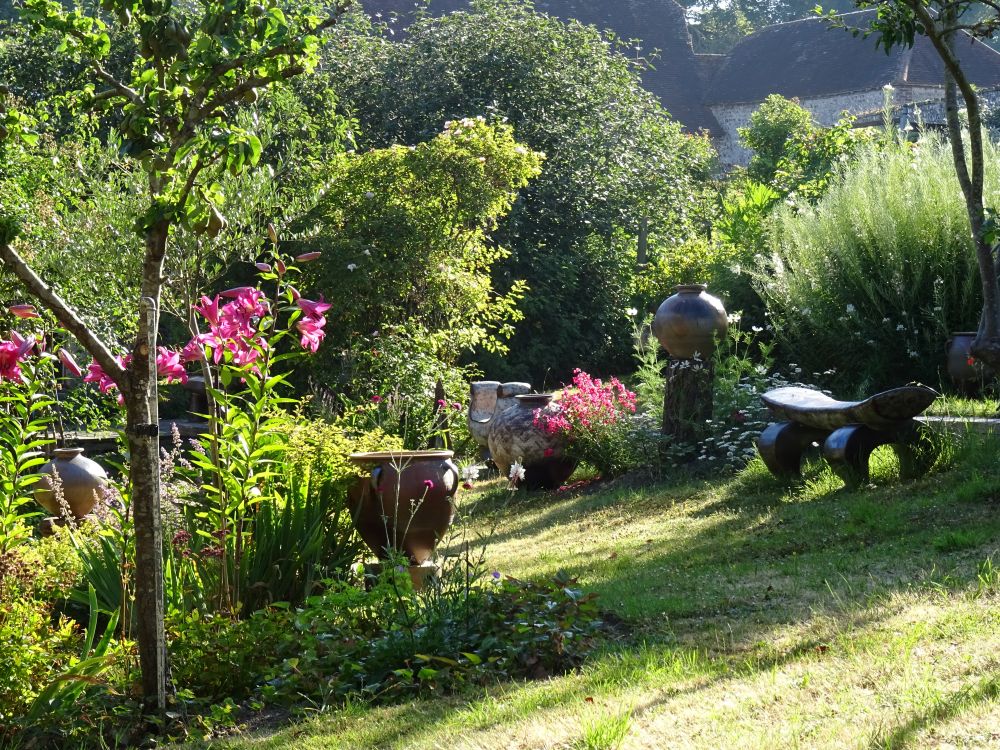
The soil here is dry and poor, so Rachael has learned to embrace what wants to grow. Plants like scilla, Welsh poppies and primroses flourish, giving way to clouds of cow parsley, comfrey and ox eye daisies as the seasons turn, while shrubs create texture. In the Pottery Garden in front of the house there are curated pools of planting beneath the fruit trees, along with more formal vegetable and fruit beds. Rachael has turned a dead tree into an archway bedecked with Indian cowbells, adding sound (and more clay features) to the space. The upward incline highlights the shapes of Chris’s pots that anchor the ephemerality of the flowers. It is a garden designed for meandering, for admiring craft, and for engaging with – Rachael has pruned an old apple tree to provide perfectly positioned branches for children to clamber up.
Whether you come for the garden or for the pots, you’ll discover that both are inseparable. This is a place that’s rooted in soil, decorated by clay, and driven by creativity and craft.
Exhibition & Open Garden: May 24-25 | May 31-June 1 | June 7-8 | June 14-15 | 11am-5.30pm | Homemade lunches, teas and cakes available in the garden | South Heighton Pottery, Newhaven, Sussex, BN9 0HL